Homily, 50,000 Days of Parish Ministry
A Celebration of 50,000 Days of Parish Ministry (2026)
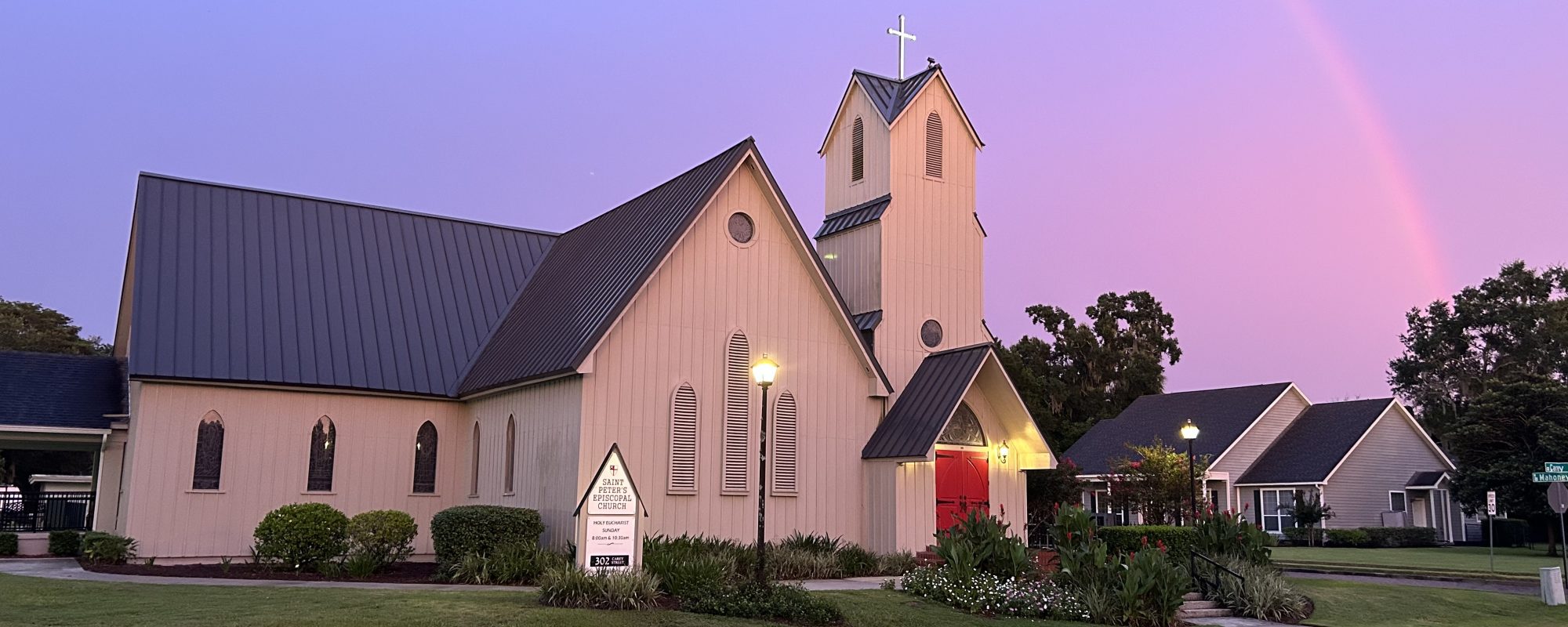
St. Peter’s Episcopal Church
Plant City, FL
The Rev. Derek M Larson, TSSF
Today’s Lectionary Readings:
Leviticus 26:9-13
Psalm 100
1 Corinthians 12:12-27
Luke 10:1-2
In the name of God: Father, Son, and Holy Spirit. Amen.
Let’s start with some trivia.
Who is credited for establishing St. Peter’s as a mission 55,000 days ago today in 1889?
It was Dr. Olin S. Wright! If you know a little about our history as a parish you might think it was John Henry Weddell, our first priest, but actually as influential as Fr. Weddell was, he never even lived here. For the 23 years he served this church he lived 15 miles away (before the automobile) on Lake Thonotosassa as a pioneer missionary overseeing many new churches. At most he visited St. Peter’s once a month or a few times a year.
But it was Dr. Olin Wright whose daily prayers and dreams led to the establishing of this church. It was Dr. Wright who purchased the property for the building of the church. And though it was Fr. Weddell who designed and oversaw the construction of our beautiful church in 1908, it was Dr. Wright who was the chairmen of the fundraiser committee for that construction. This church was built on the ministry of Dr. Olin Wright.
Next question.
Who had a St. Peter’s holiday named after them in honor of their years of ministry?
It was Mrs. Mary Dormany. Mary was a steadfast member of this parish for 66 years. She also served to help raise funds to build the church, and her family in many ways cared for it for many years. When she turned 80 in 1968, the parish named her birthday, August 17th, as Mary Dormany Day. The church was sustained by the ministry of Mary Dormany.
Ready for another one?
Who has had the longest tenure in the leadership of St. Peter’s in its 50,000 day history?
As far as I can tell, that would be Colonel William Travers Whitney who served for more than 25 years as senior warden and for whom we name our newly remodeled history hallway in Bender Hall.
There are more than 30 priests who have served this congregation. Only 8 served it for more than 5 years. Only five served more than 10 years. Only 2 served more than 15 years. But Colonel Whitney served as a member of this congregation for 46 years and more than 25 as the Senior Warden. The church continued by the ministry of Colonel Whitney.
Here’s a final one.
There are four buildings on our campus named after people. Who are they named after?
We have Bender Hall named in honor of the ministry by Jack and Emily Bender. We have Davenport House, named in honor of the ministry of Davy and Nellie Davenport. We have the Pou House, our rectory, named after the ministry of William and Maida Pou. And finally, we have Hargrave House, our office building, named after Bishop William Hargrave, the first bishop of this diocese. Out of four buildings, one is named after a clergy person, but three are named after lay people. Our church campus exists by the ministries of the Benders, the Davenports, and the Pous.
Today we celebrate 50,000 days of parish ministry and as we look back we can clearly see that the ministry of St. Peter’s belongs not primarily to clergy, but to you, the lay people of this parish.
In our gospel passage this morning Jesus sends out seventy people into the country between Galilee and Jerusalem to proclaim God’s mission to the world. He tells them, “The harvest is plentiful, but the laborers are few. Go on your way.” And so they go and when they return they are filled with joy at the things they were able to do in Jesus’ name.
But who are these people? Who are the seventy that Jesus sends out?
This is the only time the seventy are mentioned in the entire Bible. And yet they must have been important to be sent out by Jesus and have their mission recorded.
It’s interesting because this passage in chapter 10 is almost a mirror image of a passage in chapter 9 where Jesus sends out his twelve disciples to proclaim God’s mission to the world.
In both passages the missionaries are sent out to heal the sick, to cast out demons, and to proclaim God’s kingdom. In both passages they are to take nothing with them for the journey. In both passages they are told to stay in one house per village. The difference is, we know who the disciples are. We know the stories of James and John. Of Peter and Andrew. We’ve heard the names of Judas, Matthew, and Philip. But who are these seventy?
Perhaps rather than simply a few of Jesus’ followers, the seventy represent all those who volunteered to participate in God’s mission in the world. Not just a select few, but all who answered Jesus’ call. Perhaps this passage is teaching us that the mission of God is reserved not just for a few but for all those willing to take it up.
See, for us, the twelve point us back to the line of apostolic succession. The twelve were the first bishops of the Church, spread throughout the world. Traditionally the twelve point us to the ministry that has been handed down to bishops, priests, and deacons throughout the ages. The twelve are a select few with a unique role in the life of the Church.
And yet, here in the gospel of Luke the work of ministry is done not only by the twelve, the select few, but by all who are willing to accept God’s call in their lives and are then sent out into the world. If the twelve disciples represent for us the ministry of clergy, the seventy represent you, the lay ministers of the church. We are all called to do God’s work in the world.
And this is a foundational belief in our church. Take a moment and open to page 855 in The Book of Common Prayer in front of you. In the back of the prayer book there is a catechism of what we belief in the Episcopal Church. It’s a great resource. But take a moment to open to page 855. What does it say?
“Who are the ministers of the Church? The ministers of the Church are lay persons, bishops, priests, and deacons.” Lay persons first! That’s you! You are the ministers of this church.
It is your ministry that carries it into the future day by day. It your daily prayers that sustain it with the presence of the Holy Spirit. It is by your generosity that this sacred place stands each morning here as a sanctuary for the weary and a vessel of the holy.
Bishops, priests, and deacons play an important role in the Church, but our primary vocation is to empower you sacramentally for the work of ministry—the work to which God is calling you.
You haven’t called me to this parish to do ministry for you, but to do it with you, and to help you grow in your vocation as Christians serving others to the glory of God. We have one priest in this congregation. We have many ministers. You are the ministers of St. Peter’s.
For 50,000 days this parish has been sustained by the prayers and ministry of its people. Today we celebrate that. We celebrate the ministry of Dr. Wright and Mrs. Dormany. We celebrate the ministry of Colonel Whitney, the Benders, the Davenports, and the Pous. We celebrate the ministry of Booths, the Simmons, the Trasks, the Gatliffs, the Blevins, the Edisons. The Bradleys, the Coons, the Stevens…
We celebrate your ministry. And as we celebrate 50,000 days of this parish, we pray for 50,000 to come. By God’s good grace, and by the gift of your ministry in the world.
Questions for Reflection
- How do I see my role as a lay minister in the church, and what specific gifts do I bring to our community’s ministry?
- In what ways can I deepen my prayer life to support the ongoing work and mission of St. Peter’s?
- Who are the individuals in my life that inspire me to serve others, and how can I embody their spirit of ministry in my own actions?
- What obstacles do I face in answering God’s call to ministry, and how can I overcome them to participate more fully in the church’s mission?
- How can I more actively engage with my fellow parishioners to foster a spirit of collaboration and shared ministry in our community?

