Homily, Dancing at the Wedding Feast
The Twentieth Sunday after the Pentecost, Proper 23A (2026)
St. Peter’s Episcopal Church
Plant City, FL
The Rev. Derek M Larson, TSSF
Today’s Lectionary Readings:
Isaiah 25:1-9
Psalm 23
Philippians 4:1-9
Matthew 22:1-14
In the name of God: Father, Son, and Holy Spirit. Amen.
I wonder if you have had the opportunity to see the cool dance moves of my four-year-old son, Alaster. What a dancer!
We dance around some at the house, but I first really noticed Alaster’s moves last year at my sister-in-law’s wedding. She was married up in the mountains of Asheville, in a beautiful barn-turned-wedding venue. And there, surrounded by friends and family, was Alaster, three years old at the time, in the center of the dance floor, turning all the heads. Going at it, full of joy and energy. You couldn’t help but smile and cheer him on.
Me, on the other hand, I’m a bit of a wallflower when it comes to dancing. My body just doesn’t seem to move like that. Or perhaps my brain overthinks it. So I settle for a nice bob of the head and tapping of the foot. Every once in a while, I throw a hand up. I’ll spend a few minutes in the circle, but then find an excuse to fill my glass or nibble on a brownie. And while Alaster and everyone else are having the time of their lives, I’m off to the side trying to look distracted.
Have you ever felt like that? Surrounded by folks who seem to know all the steps to a dance you don’t know?
I’m thinking about that wedding and Alaster’s dance moves this morning as we hear our Gospel reading.
Admittedly, it’s a difficult passage. One with violence and judgment and seemingly not much of a moral to the story. But parables are often like that. Parables are hard to open. They can feel like secret codes we have to decipher, or puzzles we have to solve.
And we won’t solve this one in ten minutes. But it helps to remember what parables are not. They are not allegories, where every character represents something else. They are not predictions of God’s future actions. They are not prescriptions for how things should be. They are stories. Stories that invite us to think. Stories that offer images that help us see the world anew.
And at the center of this story is a wedding banquet.
“The kingdom of heaven,” Jesus says, “may be compared to a wedding banquet.”
The kind of party where family and friends from near and far gather to celebrate. Where there is feasting, laughing, staying up late into the night. Where there is dancing—not the kind you find in a city club, but the kind where families cheer on the wild, goofy moves of a three-year-old in the center of a circle.
The kingdom of heaven is like a wedding banquet.
But that is not quite what we see in our passage this morning. Yes, there is a banquet. And perhaps that dissonance is part of the point: a story of a wedding banquet in which there is no dancing.
It’s not that there was no music or food or anything to celebrate. Everything was prepared. It was the wedding of a prince! But the guests did not at first come. The invitations had been sent. The table had been set. And no one showed up.
So the king sends for more guests, and they come! From near and far, good and bad, until the hall is filled. And the feasting and dancing finally begin!
But then comes the strange encounter with a guest not dressed for the occasion. Someone who is present, but who, we might imagine, has not really entered into the celebration. Someone standing off to the side, a wallflower, missing out on the joy within the circle.
The kingdom of heaven is like a wedding feast. But sometimes we are like invitees who refuse to come. Or like guests who show up but never quite join the celebration. And the story asks us: Will we come? And will we join the dancing?
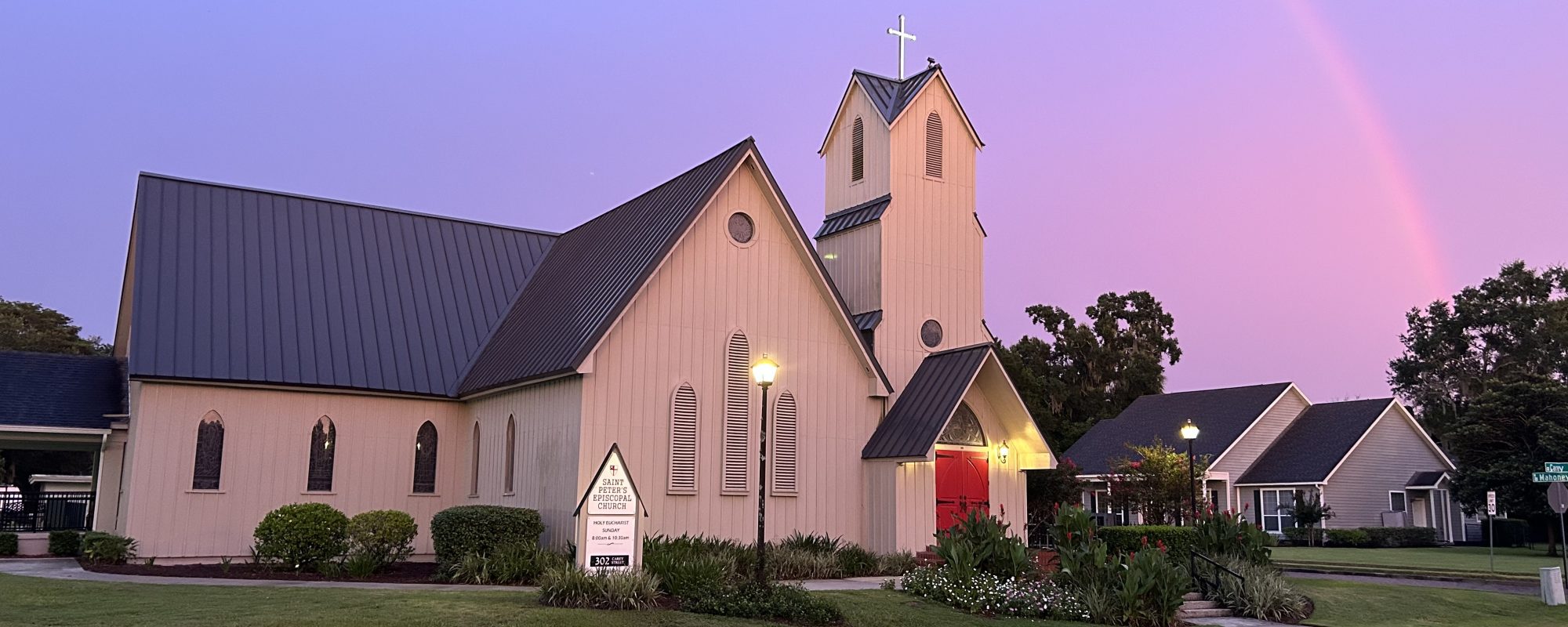
You know, St. Peter’s is like a wedding feast.
It’s the kind of place where people gather week by week to feast, laugh, and celebrate. Where people sing at the top of their voices. Where a three-year-old dances wildly during the processional hymn—I’ve seen it in St. Nick’s Chapel! Where young and old, quiet and exuberant, gather around a common table.
And of course St. Peter’s is like a wedding feast, because we are a glimpse of God’s kingdom. The very kingdom Jesus talks about in this passage.
This altar is a table at the wedding feast of God.
And each time we gather here, we answer God’s invitation to celebrate with angels and archangels and all the company of heaven.
But the invitation is not simply to attend. To show up. It is to participate. To enter into this common life, to give ourselves to it, to join the dancing.
Today we kick off our 2027 Pledge Campaign: We Celebrate Children and Youth. I invite you to think about pledging as dancing: one way we participate in the wedding feast of God.
Not because God needs our money. Not because a pledge is the price of admission. The feast is already prepared, and everything we give comes from the abundance God has given us. But because this is our community, our common life, our place at the table. And because there is something wonderful happening here at St. Peter’s, something worth celebrating and giving ourselves to. Pledging can be participation in that. It can be a kind of coming from the sidelines to join others in the dance floor.
This year, as our children’s and youth ministries have come to a pivotal moment of growth and transformation, we are placing a special emphasis on our ministries to and with them, and I am thinking back to that wedding in Asheville and what a beautiful image that is for this moment.
At the wedding there wasn’t one dance floor for the children and another for the adults. There was one great celebration. Grandparents and grandchildren, old friends and new, people who knew all the moves and people who didn’t. And right there in the middle was a three-year-old boy, dancing with all his might.
That’s what I hope St. Peter’s will always be: a community where children and youth aren’t waiting on the sidelines until they’re old enough to join the celebration. They already belong. They already have a place at the table. And sometimes they show the rest of us how to dance.
This morning we are celebrating the children and youth already part of our common life, and making a commitment to grow these ministries in the coming year. And today we share two big announcements about how we plan to do that. And we want you to participate.
Over these next few weeks, I invite you to prayerfully make a financial pledge to sustain the daily ministry of St. Peter’s: our worship and prayer, pastoral care, formation and outreach, and especially this new investment in children and youth. Whatever the amount, a pledge is one way of saying, “I want to be part of this. I want to help make it possible.”
The kingdom of heaven is like a wedding feast. The music is playing. The tables are set. And we have all been invited.
So, my friends, let’s not get caught dressed for another occasion. Let’s not spend the whole evening standing along the wall, tapping our feet. Let’s take a lesson from a three year old and step onto the dance floor, throw our hands in the air, and join in the joy of what God is doing among us. Amen.
Questions for Reflection
- In what areas of parish life do I feel like a wallflower, hesitant to fully engage and join the celebrations happening around me?
- How can I better embrace the invitation to participate in my parish community?
- What does children’s and youth ministry mean to me?
- What does it mean for me to dance with joy in my life, particularly in my relationships with others and my service to the community?
- How might making a financial pledge or commitment serve as a step towards deeper participation in the life of my church and its mission?

