Homily, Daughter
The Second Sunday after Pentecost, Proper 5A
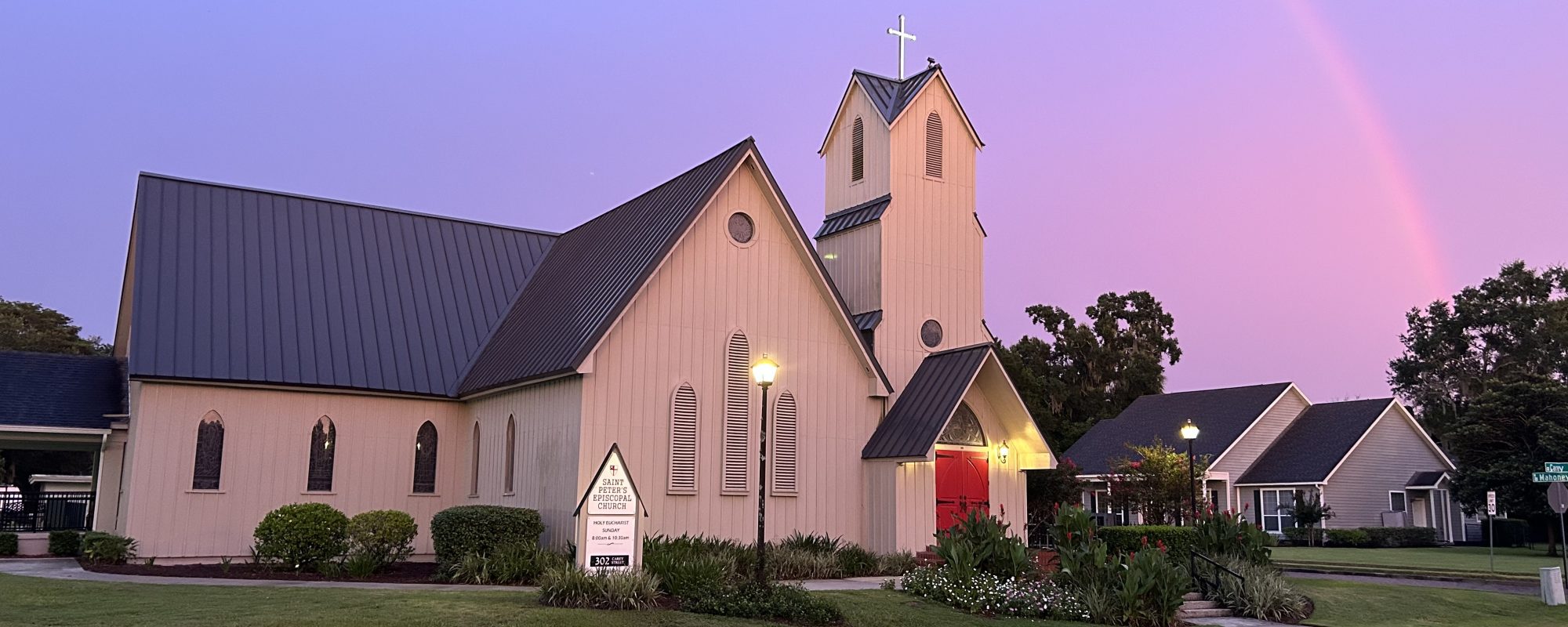
St. Peter’s Episcopal Church
Plant City, FL
The Rev. Derek M Larson, TSSF
Today’s Lectionary Readings:
Hosea 5:15-6:6
Psalm 50:7-15
Romans 4:13-25
Matthew 9:9-13, 18-26
In the name of God: Father, Son, and Holy Spirit. Amen.
It is so good to be back with you after a time away! I am so grateful for the support and encouragement from this parish to take a leave of absence after the birth of our daughter, and especially grateful to Pastor Pam and Deacon Denise and Christy Lyle and the rest of our leadership for filling in the gaps for me. Thank you!
It is wonderful having a newborn in the house again. It’s been four years since our last birth and it’s amazing how much you forget in that time, and yet it is also amazing how quickly it all comes back. But it’s not all fuzzy feelings. Babies are stressful! No matter how old our children are we all worry about them, but babies…Wow. They are so small and helpless. And I find myself worrying about every little thing. Is this normal, is that normal? Is she gaining weight fast enough? Is she eating well? Is she too cold? Is she too hot? I can’t tell you how many times I’ve walked past her crib only to stop and stare at her to see if that belly rises and falls.
But then I found the coolest little gadget. The sock. A special sock that you can put on her sweet little foot while she sleeps at night and it sends straight to your phone live reports of her pulse AND oxygen levels and will automatically alert you anytime something’s not right. Isn’t that wonderful? Now I don’t have to stare and wonder if she’s breathing. Maybe that’s a bit much, but for this father, it lets me sleep better at night knowing my daughter is alright.
This morning as I hear this gospel passage, I hear it with fresh ears. A father falls down at the feet of Jesus and begs him, “My daughter has just died, but come and lay your hand on her and she will live.” My daughter. I can no longer see her belly rise and fall. My daughter.
And so Jesus goes with him. And all the people are gathered around mourning. But Jesus walks right through them, takes up the little girl’s hand, and she lives. “The girl is not dead, but sleeping,” he says. And all is made well.
Jesus heard the prayers of a father for his daughter, and his daughter was made well.
It’s not always the way it happens. Healing comes in many forms. Not every dead child in Israel was raised again. Not every wounded body stopped being wounded. Sometimes healing comes in other ways less obvious to the eye. But in this story we glimpse the healing power of Christ’s presence that he desires for all, through the faith of a father for his daughter.
And there’s another part to this story. Sandwiched right there in the middle as Jesus made his way to the little girl’s home. A woman comes carrying twelve years of pain with her and thinks to herself, “If only I touch his cloak, I will be made well.” And so she quietly approaches and reaches out and touches it. And as she does Jesus turns and sees her face to face. And what does he say? “Daughter. Take heart. Your faith has made you well.”
He calls her daughter.
So right there as Jesus follows the desperation of a father who will stop at nothing to take care of his daughter, he looks upon a woman with that same unending love and calls her daughter. And she was made well.
I wonder what it would have been like if it had been you there on the road reaching out to touch the garment of Jesus. I wonder what burden you would have been carrying for those twelve long years. What sickness. What grief. What pain. I wonder what it is that had stopped your chest from rising and falling. And I wonder how it would have felt if upon touching Jesus’s garment he turned and looked at you and said, “Daughter. Son. Child.”
“I have not come to call the healthy but the sick. The wounded. The hurting. Those whose breath has gone out of them. Those whose pain has flowed out of them for twelve long years… Those who are well are in no need of a physician, but those who are sick.”
Our passage begins with those words seated at a table of outcasts. “Those who are well are in no need of a physician, but those who are sick.” And the saying gives a window into how Jesus saw his vocation as Messiah and Savior. He wasn’t looking for those whose lives were all put together. He wasn’t looking for those untouched by grief. He wasn’t looking for those who had all the right answers. He was looking for the lost. The hurting. The mournful. The burdened. The angry. The despondent. The questioning. The ill. The pushed-to-the-side.
The table at which he sat was not meant for the lucky, the privileged, the perfect, and the righteous, but for everyone else.
And ironically, everyone else…is everyone. For even the Pharisees had wounds unnamed, and if they had simply spoken them aloud, they would have been welcome at the table as well.
The father knelt before Jesus in his need. The woman reached out to him in hers. They named their needs. And Jesus saw them both. But the Pharisees needs went unnamed and unseen. They looked upon the table from afar in judgement rather than be seated there with Jesus.
What was true of Jesus’ table then and there is true of Jesus’ table here and now. If you aren’t sick. If you aren’t hurting. If you aren’t pained by the circumstances of life. If you are someone that hasn’t been pushed to the side. Someone who isn’t exhausted. Someone who hasn’t made mistakes. Someone who’s never been lost or confused. This table is not for you.
But if you are pained. If you are hurting. If you are lost. If you are sick. If you are confused. If you are full of doubt. If you are angry. If you are the victim of an unjust world and unfortunate events. Come, daughter. Come, son. Come, child. Take heart. For when you lay your burdens here, your faith makes you well.
Don’t be too hard on yourself and don’t carry it all alone. Come here. Come week after week. Come to Christ in prayer, and come to Christ’s body the Church to carry it with you.
There’s no need to be perfect to sit at this table. God doesn’t want your polished self. God wants whatever is broken.
And when you gaze at the altar upon the body of Christ as it is broken, know that you are gazing upon your own woundedness.
And when you touch the chalice to your lips, know that you have touched the hem of Jesus’ garment.
And when you stand again after kneeling at the rail, know that it is Christ who has taken your hand and lifted you up.
You are not dead. Your chest rises and falls still. For Christ gazes upon you as his child. And as a father for his daughter, Christ stops at nothing to see you and make you well. Amen.
Questions for Reflection
- What burdens am I carrying in my life right now, and how can I bring them to God in prayer?
- How do I perceive my own woundedness, and in what ways can I find healing and support within my community?
- How can I create a more welcoming environment for those who are struggling, just as Jesus did at His table?
- What does it mean for me to be called a ‘child’ of God, and how does that identity shape my relationship with others who are suffering?

