
Homily, Encountering Christ in the Crucifix
The Second Sunday in Lent, Year A
St. Peter’s Episcopal Church
Plant City, FL
The Rev. Derek M Larson, TSSF
In the name God: Father, Son, and Holy Spirit. Amen.
Have you ever noticed this beautiful triptych window in the front of the church? It’s been there for over 50 years. The colors are gorgeous. And when you look at it from certain angles, standing in front of it, the images themselves, pop out at you and have this incredible 3-D effect. It’s really a treasure of this congregation. After the mass I invite you to come up and take a look. You can also find it on the prayer card in your service program.
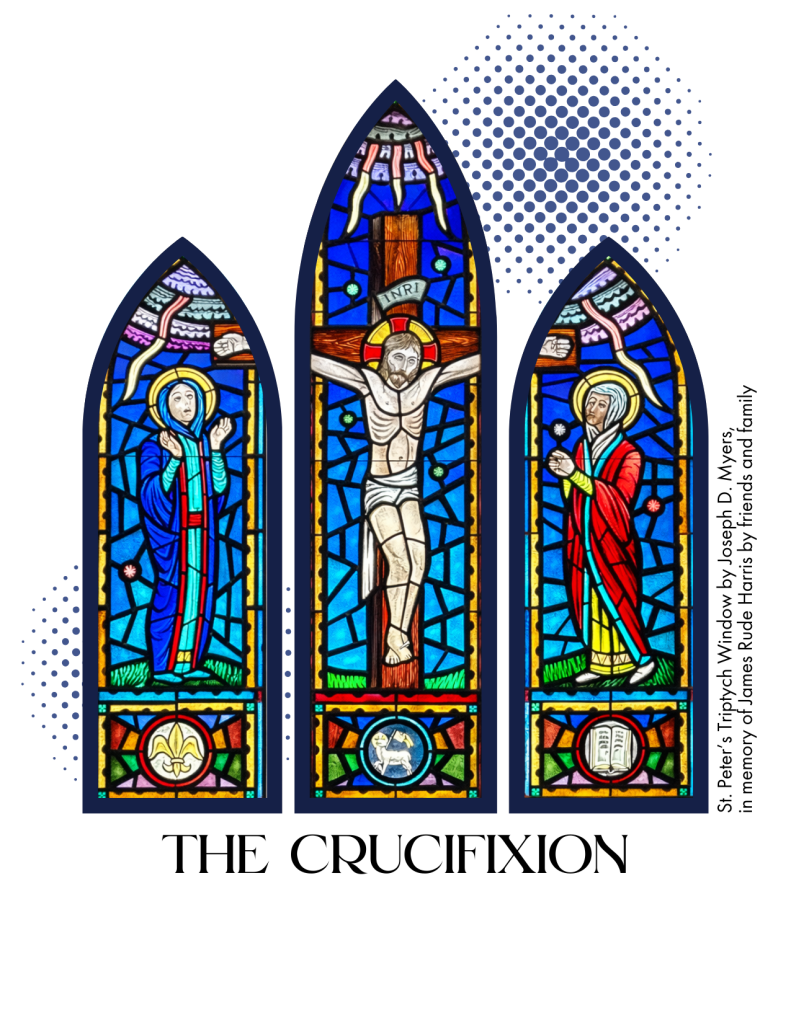
And yet it is also a difficult image to see, isn’t it? The image of a dying man.
I didn’t grow up in churches with crucifixes or images of Christ on the cross. I was told we didn’t use them because Christ is no longer on the cross; he is risen.
And I appreciate that perspective, but I can’t help but wonder if another unspoken reason for not using a crucifix is simply that it makes us uncomfortable.
The crucifix is an image of suffering, which is exactly what we spend our lives trying to avoid. Why would we want an image like that front and center in our prayer and worship? Maybe it’s better to stick with the image of an empty cross.
And yet the crucifix has a powerful lesson to teach us. For it is not only an image of suffering, but of divine love.
If you want to know what the love of God looks like, look at a crucifix. For the image of the Crucified Christ portrays not a God who is distant from us, but a God who has entered into the suffering of this world and has taken it upon himself. The Suffering Christ shows us that God sees, knows, and feels our pain. And that God has chosen to meet us there.
That is what Jesus is talking about in our Gospel this morning.
Jesus is speaking to Nicodemus, a religious leader who comes to him at night—curious, cautious, unsure. And Jesus says, “Just as Moses lifted up the serpent in the wilderness, so must the Son of Man be lifted up, that whoever believes in him may have eternal life.”
Jesus is pointing back to a story from the book of Numbers. The people of Israel were suffering in the wilderness. They were being bitten by poisonous snakes. Their suffering was real, painful, and frightening. Have you ever had an experience like that? And so they cry out to God.
And God’s response is surprising. God does not remove the snakes. God does not erase the danger. Instead, God tells Moses to make an image of the very thing that is hurting them—a bronze serpent—and lift it up. And when the people were bitten, they were told to look at it. To acknowledge their suffering and to bring it into the presence of God, and they would be healed.
Jesus says: that is what I am like.
When you look to me, lifted up on the cross, you see there your own suffering. And as your suffering is lifted up, you may know that God has seen your suffering and holds it in great love.
This is what divine love looks like.
“For God so loved the world that he gave his only Son.”
God did not stand at a distance.
God did not look down from above.
God entered the reality of human suffering to be with us and transform it into new life and resurrection.
The suffering that Christ experiences on the cross is not solely his own; it holds the suffering of the whole world—and that means it holds yours as well.
And so when you look upon a crucifix, you are looking not primarily at a historical image of the moment of one man, you are looking into a mirror. When you gaze upon it, it is not only Christ’s suffering you see, but your own.
The crucifix reminds us that God doesn’t come just to the good and easy parts of our lives, but to the painful and hard. God meets us there.
And because God is present there—because God has entered that place—suffering does not get the last word. Love does. Life does. Resurrection does.
Maybe not all at once, but all in the end.
Nicodemus may not have understood all of this when he first heard Jesus speak. But at the end of John’s Gospel, Nicodemus shows up again—and this time at the foot of the cross.
And there he sees Jesus lifted up, just as he was told. And something in him changes. In John 3, he came to Jesus quietly and privately. In John 19, he comes publicly and openly. And he brings spices—myrrh and aloes—and he, himself, helps lay Jesus in the tomb.
What changed?
What did Nicodemus see when he looked up at the Crucified Christ?
Did he see himself there?
His own questions?
His own suffering—held in the arms of God?
Did he encounter a picture of Divine love carrying the weight of himself and the whole world?
In this season of Lent each week I am inviting you to try out a different prayer practice, and this week I invite you to try praying with a crucifix.
To pray with a crucifix is to stand right there beside Nicodemus. It is to bring our suffering into the presence of a God who has already come near, and to place our faith in the one who takes it on and leads us to healing, resurrection, and new life.
When we pray with a crucifix we don’t skirt over pain and suffering, we acknowledge it, and find there that God has joined us in Divine love.
So here is one way to do that.
Step 1: Name your experience of suffering. What is it you’re struggling with? Is it an illness? Anxiety? Addiction? Worry for your children? Fear of something? What do you suffer from? Name it.
Step 2: Gaze upon the crucified Christ and see there your own suffering. Look upon him and say the words, “Christ is suffering from cancer.” “Christ is suffering from addiction.” “Christ is suffering from anxiety.” “Christ is suffering from grief and loss.”
Step 3: Receive the gift of God’s Son. Say the words, “God so loved me, God gave Christ to know my experience of addiction.” “God so loved me, God gave Christ to know my worry for my children.” “God so loved me, God gave Christ to know my experience of illness.”
Step 4: Give to God your suffering. Say the words, “I give my grief to God.” “I give my worry to God.” “I give my fear to God.” “Receive my suffering as a gift of myself to you.”
In praying these prayers you’ll slowly begin to see your suffering mingle with God’s healing. It doesn’t mean your suffering will all of a sudden go away. It’s doesn’t mean your suffering will be a good thing. It means your suffering will become holy, a place where you can experience the love of God, even amidst pain.
For God so loved the world that Christ was given to share in our suffering, that whosoever gives their suffering to Christ in faith will have new life. Amen.
Questions for Reflection
- How do you personally relate to the image of the crucifix? What emotions or thoughts does it evoke within you?
- In what ways do you find it challenging to acknowledge suffering in your life, and how might the practice of praying with a crucifix help you embrace that pain?
- Reflect on a time when you felt God’s presence in your suffering. How did that experience shape your understanding of divine love?
- How can you apply the steps outlined in the homily to a current struggle you are facing? What specific suffering might you bring into the presence of God?
- As you consider the transformation of Nicodemus from a quiet seeker to a public participant at the foot of the cross, what steps can you take to deepen your own faith journey and live out your beliefs more openly?
 Thoughts on Faith