Homily, Encountering Christ in Visio Divina
The Fourth Sunday in Lent, Year A
St. Peter’s Episcopal Church
Plant City, FL
The Rev. Derek M Larson, TSSF
In the name of the Father, and of the Son, and of the Holy Spirit. Amen.
I wonder how many of you are art aficionados. I can’t say that I am, but I can say I have a great appreciation for it. The beauty of art is something deeply powerful. The way it moves us. The way it transports our imaginations to different worlds. The way it speaks to us in ways we might not expect. Whether its music, sculpture, paintings, or dance, art has a way of piercing the human spirit.
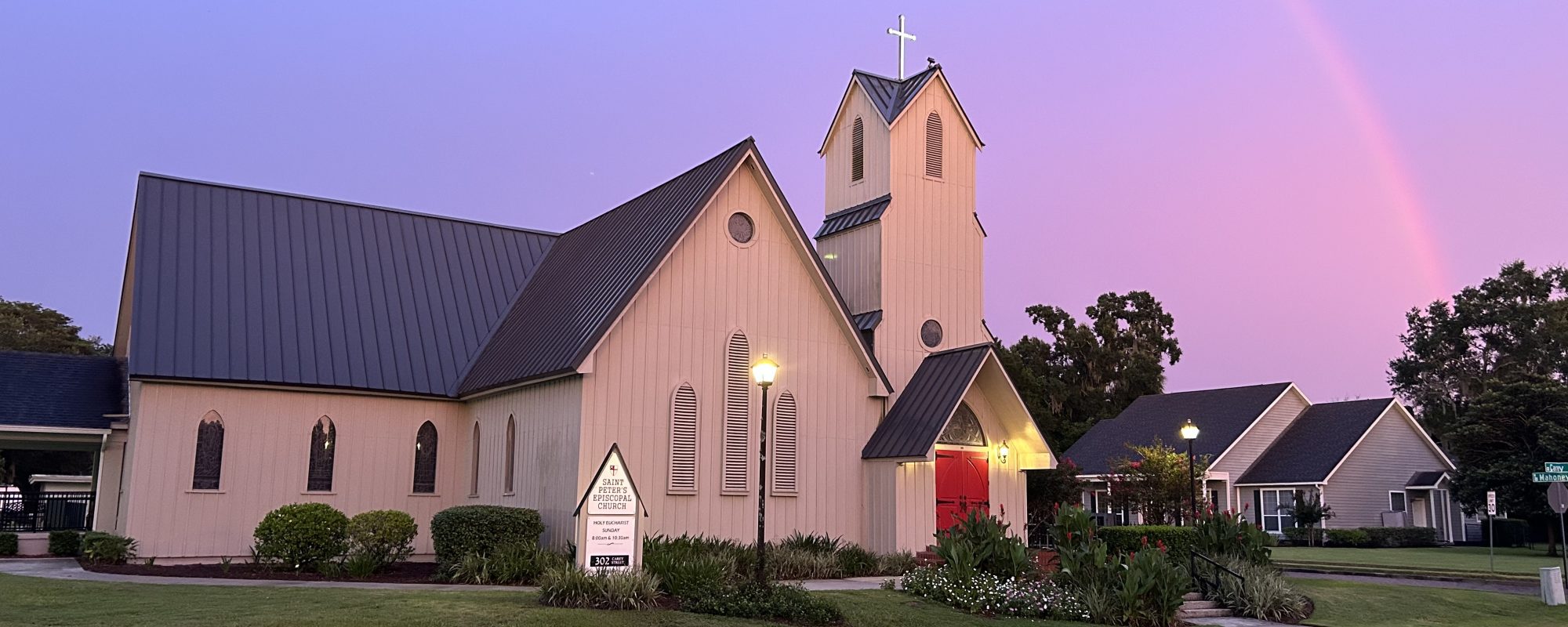
And for that reason, it has always played a significant role in the Church. We see that here at St. Peter’s, where art takes shape as icons and stained glass windows architecture. This place is full of art. And that art is intended to lead us into prayer. That’s what today’s prayer practice is all about.
Each week all through Lent I am highlighting for us spiritual practices that we may find helpful in this season and throughout our lives. So far, we’ve talked about the Daily Examen, the Crucifix, and the Beloved Prayer. Today we talk about Visio Divina.
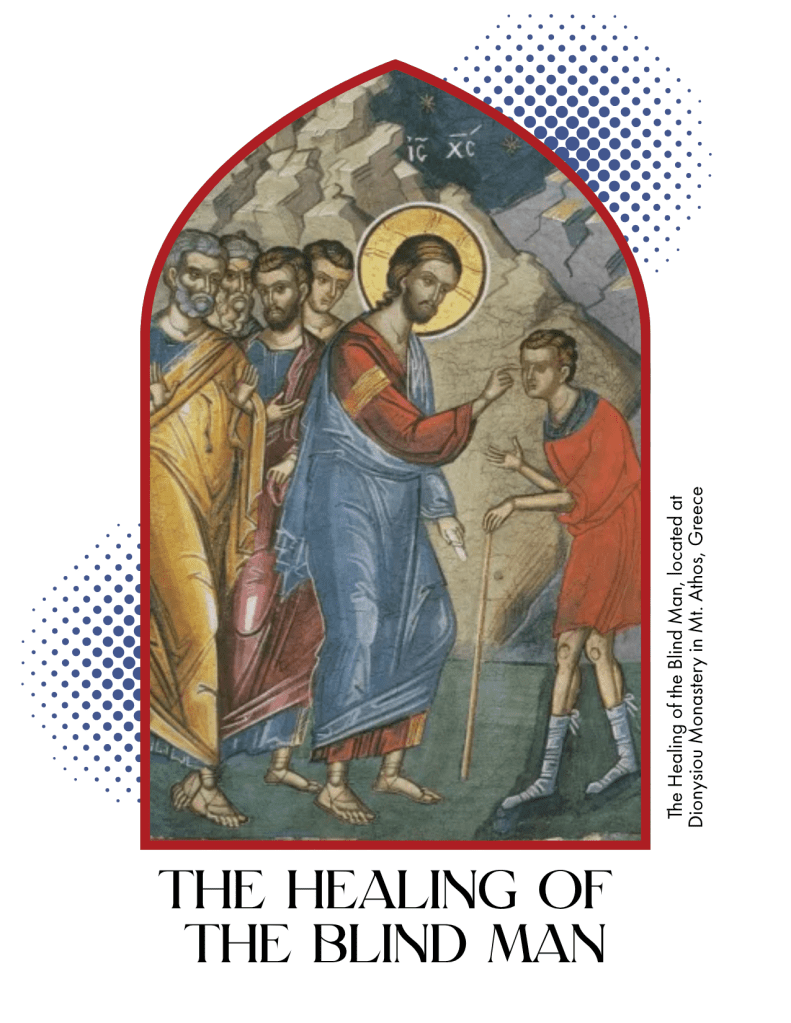
Visio Divina. It means Sacred Seeing in Latin, and is all about allowing art to lead us into prayer. So this morning I’d like to try out this practice together, and for our subject I’ve chosen a 16th century depiction of our gospel reading today: The Healing of the Blind Man, located at Dionysiou Monastery in Mt. Athos, Greece, a large monastic community in the Eastern Orthodox tradition. You’ll find the image on the prayer card in your service program. Let’s see how the practice of Visio Divina can draw us deeper into this story and the heart of God.
After selecting a visual art form to pray with and finding a comfortable place to sit, we relax and take a few deep breaths, asking God to speak to us in our viewing.
The first step is to survey the entire picture. Notice the colors, the shapes, the lighting. Look to both the foreground and the background. Look to see what is happening in the image. (Pause)
You can see in this image Jesus and the man who had been born blind are standing in the center. Jesus is touching his eye. On the left there are onlookers witnessing the event. The colors are bright and dominated by blue with a striking contrast of yellow. It’s beautiful.
Having surveyed the entire image, then allow your attention to gravitate towards one thing. What sticks out to you? What is drawing your attention? What curiosity do you have? (Pause) We call this step Visio.
For me, it’s their hands. The hands of each figure is doing a different thing. Jesus’ hand is touching the blind man’s eye. The blind man is holding a cane with one hand and has a palm out with the other. The onlookers have either closed hands or hands with palms out and held close to their bodies. Jesus and one of the onlookers seem to be holding something in their hands.
The second step is to spend some time reflecting on that part of the image that has drawn your attention. Why do you think that part captured your attention? What do you think God is saying to you? Do you perceive some meaning or significance for that part of the image? Does it somehow connect to your life or experience? Do any memories arise in you? How is God using this image to speak to you? (Pause) We call this step Meditatio.
For me, I notice the posture of the figures’ hands reveal the posture of their hearts. The man who had been born without sight has a receptive posture. With his open palm he is able to receive something new. He is open to having his experience changed. He is ready to experience the presence of Christ. He is not closed or defensive in his posture, but welcoming and available. And that’s really the demeanor demonstrated throughout the Scripture passage. Not only is he able to receive sight from Jesus, at the end of the passage he is able to receive belief in Jesus, the Son of Man. And he fell down and worshiped him.
By contrast the onlookers have either closed hands or hands which seem to put distance between them and Jesus. The primary figure has both his hands up and close to his chest as if to say, “Stop!” Or “I’m staying out of it.” Rather than hands of welcome, his hands are meant to divide and segregate. We also see this in the passage. Despite testimony after testimony, the Pharisees refused to believe that this man had been given sight or that God’s Spirit was upon Jesus. In fact it says they drove the man out of the synagogue.
On the surface this passage is about seeing, but on a deeper level, this passage is about perceiving. The man who cannot see has hands which demonstrate his perception and receptivity to the moment. The ones who can see have hands which demonstrate their lack of perception or willingness to open their worldview to the hand of God. The image makes you wonder, who am I in this story? Are my hands open and ready to receive or are they distant and put up as a barrier?
The third step is to allow these reflections to move us into conversation with God. We have heard God speaking to us in our reflections; now what is our response to God? How does our heart speak to God’s heart? We call this step Oratio.
“God, help us to be receptive to what you have for us. Help us to get past the attachments and pride and skepticism which put up barriers between us and the work you are doing in this world. Make us ready to be surprised by the places we find you, so that when you are near we will not pass you by. God, give us open and receptive hands.”
The final step is to spend a few moments resting in God’s presence. Having journeyed through the image and allowing ourselves to be changed by it, we pause and perhaps close our eyes, to lovingly rest in the presence of God. We call this step Contemplatio. (Pause)
Art is such a powerful thing. And when we apply it to prayer, it truly becomes for us a sacred way of perceiving and listening to the voice of God. I invite you to spend some time with this or another image this week and let it become for you a vessel of prayer. And Let us like the man in our story, find ourselves open and ready to receive God’s voice in the midst of it’s beauty. Amen.
Questions for Reflection
- In what ways do I currently exhibit receptivity in my faith journey, similar to the blind man in the story? Are there areas where I am more closed off?
- How can I cultivate a more open posture—both physically and spiritually—toward God and the work God is doing in my life?
- Reflecting on the art image discussed, what aspects or details resonate with my personal experiences or challenges? What emotions does this bring up for me?
- What barriers do I recognize in my life that prevent me from fully engaging with God or receiving God’s gifts? How might I begin to dismantle those barriers?
- How can I incorporate the practice of Visio Divina into my prayer life this week? What images or works of art might guide me deeper into my relationship with God?
 Thoughts on Faith