Homily, God’s Final Vision
Sixth Sunday of Easter, 2025
St. Peter’s Episcopal Church
Plant City, FL
The Rev. Derek M Larson, TSSF
Today’s Lectionary Readings:
In the name of God: Father, Son, and Holy Spirit. Amen.
Today in our Second Reading we hear from the last chapter of the last book of the last testament of the Christian Bible. Revelation 22. In it we hear a vision from John of the New Jerusalem coming down out of heaven to establish itself as a city of peace for all nations with Christ the Lamb upon the throne at it’s center. But I’m thinking about the first chapters of the first book of the first testament of the Bible. Genesis 1-3.
There are a lot of similarities.
In both passages there is the Tree of Life.
In both passages there is a river.
In both passages God does not stand far off but dwells with and walks with humanity.
But more striking are the differences.
In Genesis a sun and moon are created.
In Revelation there is no sun or moon, but only the light of God.
In Genesis there is first one and then two people.
In Revelation there are nations upon nations of people.
In Genesis there is a garden.
In Revelation there is a garden city.
In Genesis the is fruit forbidden that leads to death.
In Revelation the fruit and its leaves are for eating and healing.
In Genesis, after the sin of Adam and Eve, there are gates that are closed and guarded.
In Revelation there are gates that are never shut.
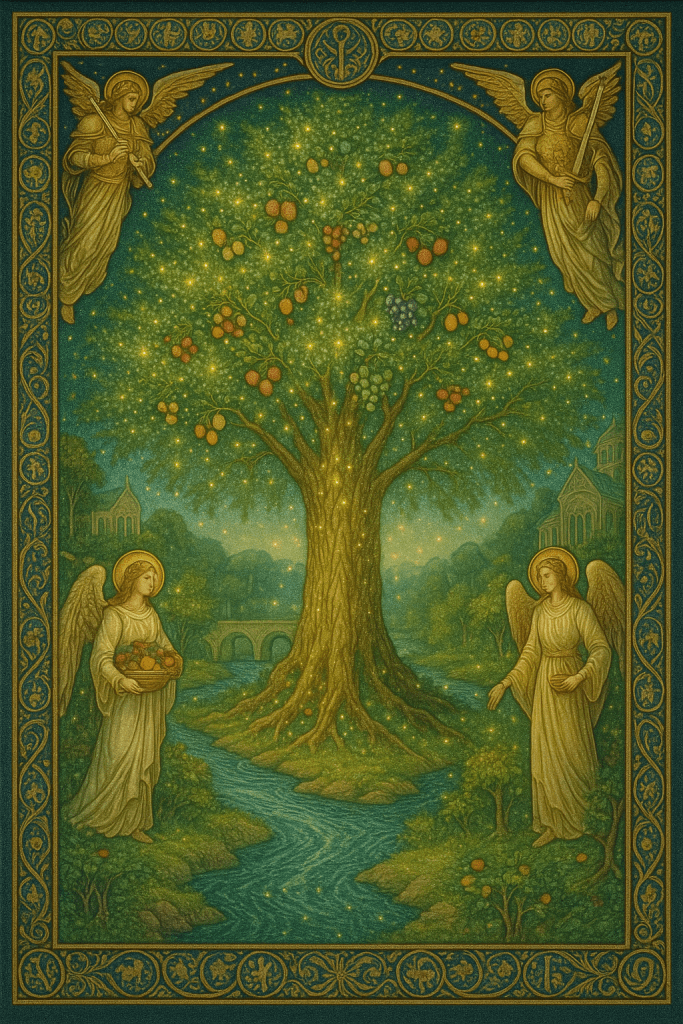
Genesis and Revelation are part of the same story. And this passage in Revelation is not just a closing chapter—it is the story’s fulfillment. It returns us to the beginning, where everything was made good, but everything also went wrong—and it makes things right again. This is the culmination of the entire work of God. This is the pinnacle of the Gospel’s promise. This is God’s final vision for humanity.
And what do we see in it?
Welcome.
In this grand vision revealed to John all the nations of the world are welcomed to the holy city of God. The gates to this blessed community are never shut. And all are loved and cared for with Christ the Lamb upon the throne.
In the beginning, God created humanity for loving community, but we so often turned away. Time and time again throughout Scripture, God calls God’s people back to loving community. And time and time again, we fall short of God’s call. But here—in this final vision—God gets what God always wanted. With Christ at the center, loving community is what we have.
And if anyone is left out, it is not because of who they are or what might be their circumstances or God’s desire, it is because they have rejected loving community, the very thing God has desired from the beginning. The city with open gates for all the nations in this passage is the fulfillment of all of Scripture—it is what God has been building all along.
And this is why I love to talk about our mission statement at St. Peter’s. I’ve probably mentioned it in at least five homies this year so far. To say that we are a welcoming Christian community of all ages is not simply a nicety. It is not just southern hospitality. It is not a way to boost our attendance or to feel good about ourselves. To say that we are a welcoming Christian community is to participate in this epic final vision of God for humanity.
Notice: the holy city is not far off in heaven. It is here on earth. It is brought down out of heaven from God to be close to us. To be with humanity. This is a vision not for somewhere else in some other time.
This is a vision for the here and the now. We are not waiting for this vision to fall from the sky. We’re building it with Christ—here and now. Every act of welcome, every softened heart, every open door, every healing word—it all participates in the New Jerusalem—the final vision of God for humanity. We at St. Peter’s are not waiting on that. We are part of that. Even now. We are part of this great vision. We seek to be a welcoming Christian community because this is a vision of a welcoming Christian community. A city—a community—where Christ is at the very center, and the gates are open for all. This is God’s dream. This is Christ’s work. We are participating in it.
Imagine with me in John’s vision what it might be like to stand at the open gates of the city to welcome the weary nations into the place of rest. Imagine what it would be to serve as the doorman, and to usher people into a home of healing and grace. Imagine what a gift that would be. To serve at St. Peter’s as an usher is literally that.
Imagine with me in John’s vision what it might be like to prepare the fruit of the tree of life for the table and the harvesting of its leaves so that others might find healing. To serve at St. Peter’s on the altar guild, or coffee hour, or Engage Cafe is exactly that.
Imagine with me in John’s vision what it might be like to lead someone new along those streets, showing them the way to Christ’s throne so that he may wipe away every tear from their eye. When you serve as a lector, or a Sunday School teacher, or lead a Bible study, that is what you are doing.
The meaning of the word “Revelation” is unveiling. A revealing of deeper truths and deeper realities than what we usually see on the surface level. What this vision reveals to us, is the meaning of our work. The purpose of our mission. It is not mundane. It is holy. As part of the city of God—the New Jerusalem—we are a welcoming Christian community.
What we do here at St. Peter’s is not small. It is the work of heaven on earth. So let us do our work with open hearts like the open gates of the New Jerusalem, that God’s final epic vision for humanity is made real in us. Amen.
Questions for Reflection
- How do I personally embody the values of welcome and community in my daily life, and in what ways could I improve upon this?
- In what areas am I currently resisting God’s call to participate in the loving community that He desires, and what steps can I take to overcome that resistance?
- What actions can I commit to this week that will help foster an environment of healing and grace within my community?
- How can I deepen my understanding of God’s final vision for humanity and integrate it into my personal mission and purpose?
- Reflect on a time when you felt welcomed or included in a community. How can that experience inspire you to create similar opportunities for others at St. Peter’s?
 Thoughts on Faith