Homily, Growing Down: Children and Connection
The Twentieth Sunday after the Pentecost, Proper 22B, 2024
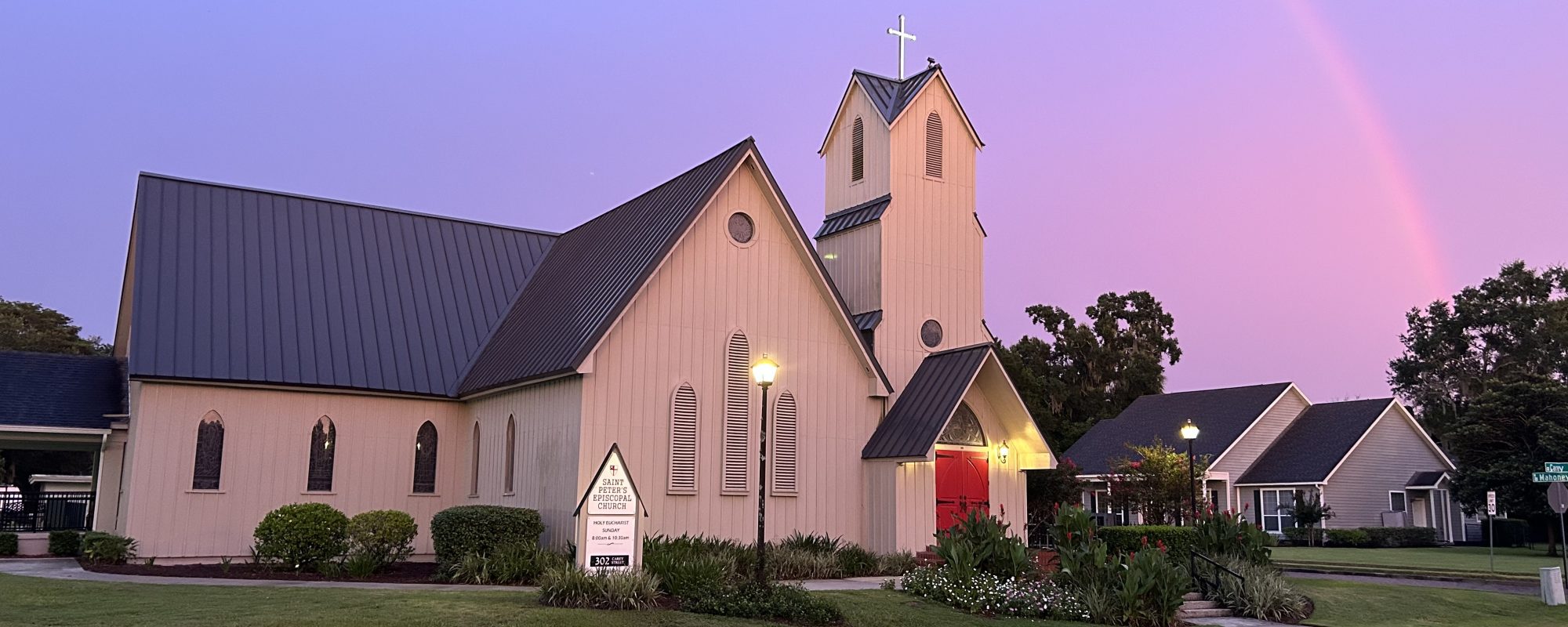
St. Peter’s Episcopal Church
Plant City, FL
The Rev. Derek M Larson, TSSF
Today’s Lectionary Readings:
Job 1:1; 2:1-10
Psalm 26
Hebrews 1:1-4; 2:5-12
Mark 10:2-16
In the name of God: Father, Son, and Holy Spirit. Amen.
My son, Alaster, who is two years old, is one of the most social people I know. Which is funny, because I am an extreme introvert. You may not know that about me yet, but I’m a homebody. I love spending time with people, but I’m naturally quite shy, and I need my alone time. But Alaster, normally, is not very shy. He loves talking to people, and does not care one bit about whether he knows them or not. A few months ago my family was taking a walk and passed by two folks we didn’t know and of course Alaster called out to them and waved, “Hi!”. They responded once and then kept talking to one another, but that wasn’t enough for Alaster. He kept on calling out, “Hi! Hi! Hi!”, but they didn’t respond again. And when they were out of sight Alaster’s head dropped and his lip puffed out and he said, “sad.” Alaster is much more social than I am. But what I’ve noticed is that Alaster is helping me become more social. When I would walk by a stranger with a simple nod or polite smile, Alaster gets us into conversations. We end up talking to more people because of his presence. And in that way, he is teaching me how to be more open to all those I meet. And he is teaching me how to “grow down” as we are calling the sermon series that we wrap up today about children in Christian community.
Not everyone is as outgoing as Alaster is, but I think generally speaking children tend to be more open and softhearted to people they meet. Children—especially young children—are more naturally relational than adults. Even when they are shy, they typically don’t ignore those around them, but watch with a keen curiosity, ready to make a connection. Children are aware of a natural connection that all humans have with one another. But as we grow so does our caution around others, and our soft and open hearts become a bit more hardened and guarded.
Soft and hard hearts is what our gospel passage is about this morning. The Pharisees come to Jesus and ask him a deliberately controversial question to try to trip him up. They do so because their hearts are hardened against him. The question is about divorce. Is it okay to divorce your wife, they ask. It’s a hard question. Jesus responds, “what does the Bible say?” “It says we can,” they reply. Says Jesus, “Well, that’s because your hearts are hard, but that’s not the way God created things.”
Now I want to pause here and acknowledge that for those of us who have experienced divorce in our lives, be it our own or someone close to us, this passage can feel like a finger poking an open wound. It’s painful to hear. And it’s been used in painful ways against many of us. So there’s two things I want to say about that. One, Jesus, in this is passage, is talking about an ideal. And it’s an ideal that we can all agree on. Ideally, divorce would not exist. It’s not what God intends. But as we all know, we do not live in an ideal world. And so while Jesus’ words here sound harsh, remember that whenever Jesus meets a person in an unideal situation, time and time again he always meets them in their pain, not with condemnation but with love. The second thing I want to say, is if you are struggling with this topic or with this passage, and you’d like to talk more about it, then please reach out, because this passage is one better approached in conversation than from the pulpit.
But here from the pulpit, instead of getting bogged down by the question of divorce in particular, I want to point out that there is something bigger happening in this passage. And it has to do with who is in and who is out.
Notice there are two sections in our gospel reading today. In this first, the Pharisees ask Jesus about how to get out of a marital union. In the second, the disciples are corrected by Jesus for keeping children out of his presence. In both cases, the Pharisees and the disciples are concerned about who belongs and who doesn’t. Who is in and who is out. They come to Jesus holding an assumption of separation. And in both cases, Jesus challenges that assumption. When the Pharisees and the disciples are focused on drawing lines in the sand which will protect their individual rights and privileges, Jesus erases those lines to emphasize unity and inclusion. People belong together, Jesus says. “What God has joined together, let no one separate.”
Jesus is talking about more than marriage here. He is talking about human connection. Humans were made to be together. According to the old creation story, God made two people, not one. And the two people come together as one. And while that is true about marriage in particular, the reason we call marriage a sacrament, is because it is true on a deeper level as well. The coming together of two people in marriage points to the deeper truth of God’s work of bringing all things into communion with one another. If you open the prayer book to page 855 you’ll see this stated very clearly in our catechism. “What is the mission of the Church? The mission of the Church is to restore all people to unity with God and each other in Christ.”
And so when we see the disciples keeping the children from coming to Jesus, they’re doing the same kind of thing as the Pharisees asking about divorce. Their hearts are hardened and guarded, open only to those they deem important enough to be near Jesus. But Jesus corrects them, and says to them, “Let the little children come to me; for it is such as these that the kingdom of God belongs. Truly I tell you, whoever does not receive the kingdom of God as a little child will never enter it.” If the hearts of the Pharisees and the disciples were hardened and guarded against others, asking questions of who is in and out, drawing lines of division in the sand, Jesus lifts up children as an example of those whose hearts are soft towards others, drawing not lines in the sand but drawing us into deeper communion and connection with one another.
We, as adults, are often much more concerned about who is in and who is out. We are often much more concerned about making distinctions and divisions among one another so that we each have our own tribe, our own team, our own party. Our default question often is: How are we different? But the kingdom of God is one in which the default question is: How are we connected? And for young children, this comes so much more naturally than we who have grown hardened and guarded towards those we meet.
A church that does not have children or separates them from the adults is a church that will struggle with having hard hearts. But a church that centers children is a church that will be lead by them into deeper connection with our neighbors, and thus deeper into our mission of “restoring all people to unity with God and each other in Christ.” According to Jesus, children are that important.
When I take a walk with Alaster and find him leading me into conversations with those we meet, he is actually leading me deeper into the kingdom of God. He is showing me how to enter God’s kingdom like a little child. And so I ask you, how are we at St. Peter’s allowing the children in this place to lead us into deeper connection with those around us and deeper into the kingdom of God?
Questions for Further Reflection
- In what ways do I exhibit a “guarded” heart toward others, and how can I cultivate a more open and soft-hearted approach in my interactions?
- Reflecting on the concept of connection, how do I actively seek to foster relationships with those around me? What barriers might I unintentionally put up that prevent deeper connections?
- Jesus emphasizes the importance of humility and openness in receiving the kingdom of God like a child. How can I embrace a more childlike perspective in my faith and relationships, focusing on inclusion rather than division?
- How can I take inspiration from my interactions with children to engage more meaningfully with people in my life and deepen my understanding of community and connection?
 Thoughts on Faith