Homily, It’s Bad Math, but Good Theology
The Twenty-Fifth Sunday after the Pentecost, Proper 27B, 2024
St. Peter’s Episcopal Church
Plant City, FL
The Rev. Derek M Larson, TSSF
Today’s Lectionary Readings:
Ruth 3:1-5; 4:13-17
Psalm 127
Hebrews 9:24-28
Mark 12:38-44
In the name of God: Father, Son, and Holy Spirit. Amen.
If there are three apples and you take two away, how many apples do you have?
Two! Listen carefully.
If there are three apples and YOU take two away, how many do YOU have? Two!
I tried that one out on my son, Barret, a few weeks ago and got him too.
It’s perhaps not a very good math equation, but it’s a great riddle.
In our gospel reading this morning Jesus is at the temple and he sits down near the offering plates where people are putting in their contributions to the temple treasury and he notices that there are a number of well-off individuals giving some pretty big gifts. But what really captures his attention is the gift of a poor widow. She gave just two small coins—the smallest of coins—but it was all that she had. Having witnessed her generosity and trust in God’s provision, Jesus points it out to his disciples, “Truly I tell you, this poor widow has put in more than all those who are contributing to the treasury.”
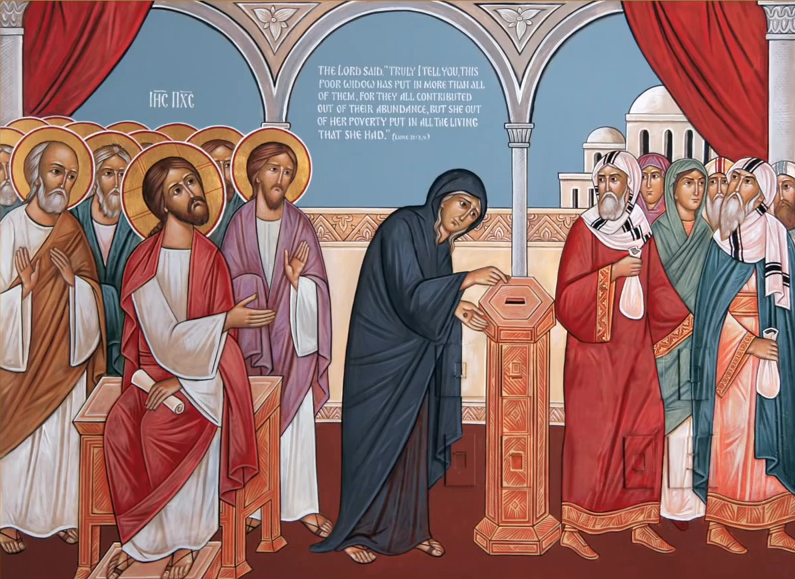
This week I was thinking about Jesus’ words, and it occurred to me that Jesus might not be so good at math. Two pennies is less than “large sums.” And however generous the gift of two pennies may be to the woman, the economic value of those two pennies does not change. Can you imagine if I paid only 50% of the amount of my bills but said them, “It’s okay, it’s a 100% of what I have”? They may work with me on a payment plan, but I’m still gonna have to pay the other 50%. Whether it’s all you have or not, 50% is not more than 100%. Two pennies is not more than “large sums.” It’s bad math.
But while it may be bad math, it’s good theology.
Jesus is always saying things like this. “Leave the 99 to go find the 1.” “Five loaves and two fish can feed 5,000.” “Give the laborers in the vineyard all the same wage no matter how long they worked.” “One mustard seed of faith can move a mountain.” “Blessed are the poor.” “Two pennies is more than large sums.” And the reason is that the logic of God has an underlying value system that is different from our own. For God, worth is not determined by the world’s economics but by a different economy altogether. An object or an action’s worth is determined not by its productive potential but by its capacity for love.
The reason the widow’s offering is judged to be greater than all the others is because she offered it with great love. And because it was offered in love, it was enough. And not only was it enough, it was more than enough. Because when we offer something in love, our offering is an extension of God. If God is love as it says in 1 John, and we offer something in love, than we offer it in God. When we offer something in love, we give not only our offering, we give God. We offer up the very presence of God to the recipient of our gift. And whatever may have been small or inadequate, if it is wrapped in God, it is enough.
There is a little line that has become a mantra in my life when I feel inadequate or unable to give what is needed. It often comes up when I’m writing a sermon that I’m not happy with. When I struggle to come up with the right words or the right images and time has run short, Sunday morning is around the corner, and I have nothing left to give to this homily, I remind myself, “I can only give what I have, not what I don’t have. And if I give what I have, God will make it enough.” I think about that young boy with the two loaves and the five fish and what God was able to do with his offering. He only gave what he had. He didn’t give what was needed, he gave what he had, and God is the one that made it enough. I don’t know what happened to those two pennies the widow gave after they were dropped in the treasury, but I bet those two pennies did something amazing, because she simply gave what she had, and she gave it in great love.
God doesn’t ask you to give what you don’t have. God simply asks you to give what you have with great love.
Today is Giving Sunday and in a few minutes we will offer our pledge cards. We will offer our intentions for how we will PRAY, PARTICIPATE, and PROVIDE for the daily ministry of St. Peter’s in 2025 and we will ask God’s blessing over those intentions. But whatever is written on those cards is not nearly as important as the love that you offer with them. Don’t get me wrong. If we give something in love then we take the time to consider what it is we are giving. But what will make it enough—what gives it real value—is not how big or small, involved or uninvolved, it is by the world’s standards, but its capacity for love. If it is given in great love, it will be enough. Even if its two pennies—or two apples—it will be enough.
And this is true not only of our pledge cards but more importantly, this is true of every aspect of our lives. Take a moment and reflect with me. Where in your life this morning do you feel inadequate? Where do you feel like you don’t have enough to give? Like it’s not just not in you. Like there’s not enough strength. There’s not enough skill. There’s not enough wisdom. There’s not enough time? There’s not enough patience? There’s not enough experience. There’s not enough hope? Where do you feel like there’s simply not enough for what is needed?
Listen. God doesn’t ask you to give what you don’t have. God simply asks you to gives what you have with love. So offer it up. Make it a gift of love and God will take care of the rest. It’s not good math, but its great theology. Amen.
Questions for Further Reflection
- In what areas of my life do I often feel inadequate or overwhelmed, and how can I shift my perspective to see that even my small contributions can hold great value when offered in love?
- How do I define “enough” when it comes to my time, resources, and energy? Am I too focused on what I lack rather than what I can offer?
- What specific actions can I take this week to practice giving what I have—whether it’s time, support, or resources—with intention and love?
 Thoughts on Faith