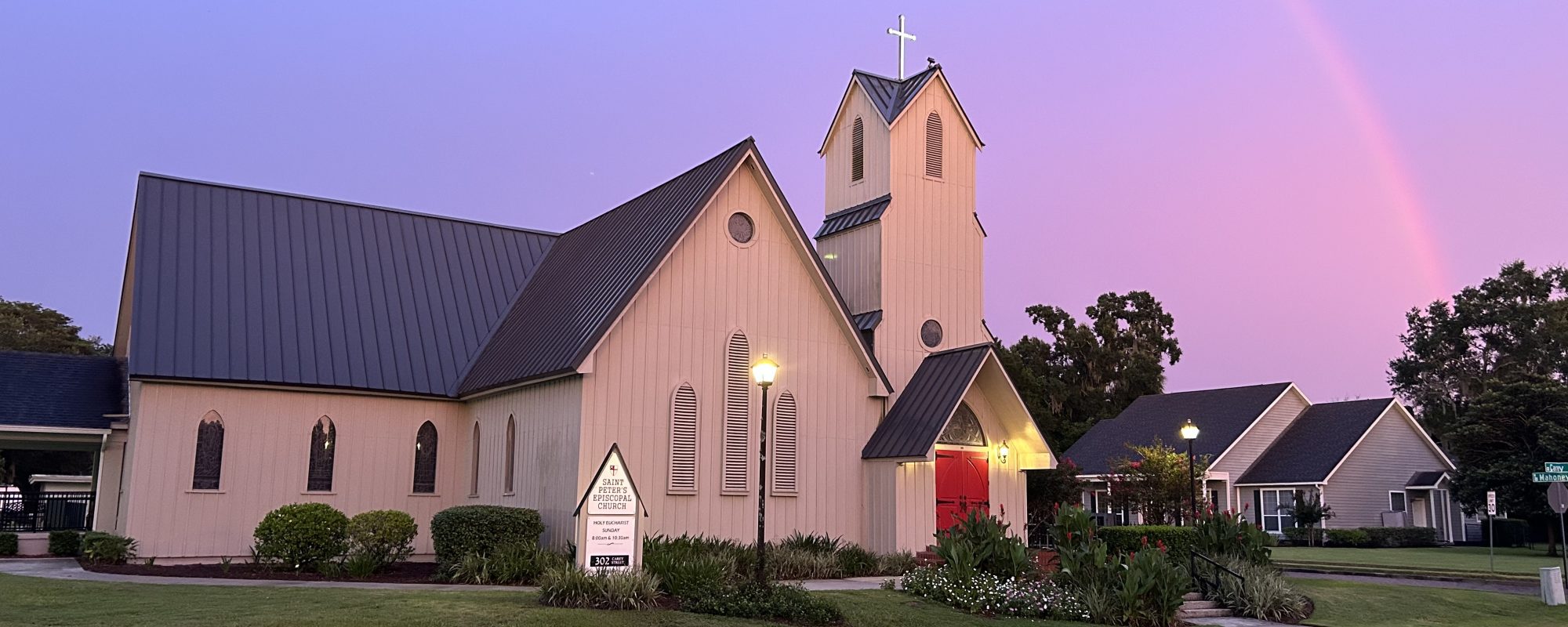
Homily, Let’s Talk to Strangers
The Twelfth Sunday after the Pentecost (Proper 17C), 2025
St. Peter’s Episcopal Church
Plant City, FL
The Rev. Derek M Larson, TSSF
Today’s Lectionary Readings:
Jeremiah 2:4-13
Psalm 81:1, 10-16
Hebrews 13:1-8, 15-16
Luke 14:1, 7-14
In the name of God: Father, Son, and Holy Spirit. Amen.
Did you know that it takes around 50 hours of time together for adults to become friends? Fifty hours! Perhaps that’s not so surprising, because most adults have a really hard time making friends. Our closest relationships are the ones we hold in our families and sometimes in our workplace. My hope is that our closest relationships will also, at times, be our church families. But it takes at least 50 hours of time spent together before becoming friends, and there are only 52 weeks in a year, so friendship is an investment that takes time.
I think, perhaps, one of the great obstacles to becoming friends, however, is simply the initial hurdle of having a first conversation. Our society as a whole is skeptical of people we don’t know. Some of us are more or less shy than others, but as a whole, we grow up learning to be cautious around those we don’t know. As children we are taught not to talk to strangers. We are taught that strangers might be a danger. And so many of us grow up with little walls around us, protecting us from the unknown.
And of course there are good reasons to be protective of ourselves and our children. There are real dangers in the world. But we also lose something when we walk through the world suspicious of all those we encounter along the way.
Perhaps our core sin as a society is xenophobia—the fear of strangers. The fear of those not like us. Xenophobia is what makes racism possible. Xenophobia is what makes the dehumanization of immigrants possible. Xenophobia is why religious violence is possible. It’s what gives rise to our epidemic of loneliness. It’s what contributes to political polarization. Xenophobia separates us from one another. We are uncomfortable around those we don’t know and we often don’t know how to relate to strangers. And so we keep ourselves closed off from them. We build walls between us. We eat at separate tables.
But Jesus offers us a different vision of the world. A different way of seeing the stranger. In our gospel passage for today he teaches, “When you give a luncheon or a dinner, do not invite your friends or your brothers or your relatives or rich neighbors, in case they may invite you in return, and you would be repaid. But when you give a banquet, invite the poor, the crippled, the lame, and the blind.” In other words, when you put on a party, don’t simply invite the people you know, invite the strangers, especially the ones that are in need. When you offer a meal, don’t simply offer it for your friends and family, offer it to those in your community that may have no friends or family.
Our second reading, from the book of Hebrews, puts it this way, “Do not neglect to show hospitality to strangers, for by doing that, some have entertained angels without knowing it.” The phrase “hospitality to strangers” is a single, compound word in Greek, philoxenia. Philosmeaning love, and xenos, again, meaning stranger. So rather than xenophobia, the fear of strangers, the Scriptures invite us to philoxenia, the love of strangers.
What a radical way of seeing the world. What would our lives look like if instead of seeing strangers around us with suspicion, we saw them with compassion? What would it look like if we saw strangers not as potential danger, but as potential angels—as vessels for encounters with God? What would it look like if we saw in strangers, the opportunity to love and be loved in the presence of Christ’s love? Can you imagine a world like that?
I am not good at talking to strangers. I am very shy. I am deeply an introvert. It’s one of the reasons I waited so long before becoming a priest. I don’t know fully how to walk up to a stranger and strike up a conversation. Maybe you’re like me or maybe you’re a social butterfly. Either way, befriending strangers is a core Christian value. It is a Scriptural mandate. When we connect with those we do not know, we are participating in Christ’s work of bringing the kingdom of heaven to this world. The mission of the Church is to restore all people to unity with God and each other in Christ. There is no possible way of restoring unity to all people without speaking to the stranger. Befriending strangers, is putting our faith into practice.
So what does that look like? I think it looks differently for each one of us and for each of our contexts. If you’re like me, you might need to start small. Say hello to the people you pass in public. At the grocery store. At work. In the park. At the DMV. Then maybe take it a step further, say “how are you?” Smile at them. Put down your phone. There are angels in your midst.
For others, maybe that’s too basic. So maybe you want to take it to the next level. Invite an acquaintance over for dinner. Ask a stranger what’s important to them. Visit the church, the temple, the mosque, of someone you don’t know.
What does it look like to love the stranger as a church community? Make room on our campus for those outside the congregation. Create partnerships with organizations with which we may not even fully agree. Take risks in welcoming those in need.
Our Christian responsibility is to make friends out of strangers—to counter xenophobia with philoxenia. So let’s throw away some of the advice we were told as children. Let’s talk to strangers. Amen.
Questions for Reflection
- Personal Barriers: What personal barriers do I face when it comes to initiating conversations with strangers, and how can I work to overcome them?
- Experiences of Connection: Can I recall a time when reaching out to a stranger led to a meaningful connection? What did that experience teach me about the value of friendship?
- Practicing Hospitality: In what ways can I actively practice hospitality to strangers in my daily life? Are there specific groups in my community that I feel called to engage with?
- Changing Perspectives: How can I shift my perspective to see strangers as opportunities for connection rather than potential threats? What practical steps can I take to approach interactions with compassion?
- Community Involvement: How can I encourage my church or community group to engage more deeply with strangers? What initiatives or partnerships could we explore to foster inclusivity and love for those outside our immediate circle?
 Thoughts on Faith