Homily, Martyrdom
The Fourth Sunday after Pentecost, Proper 7A
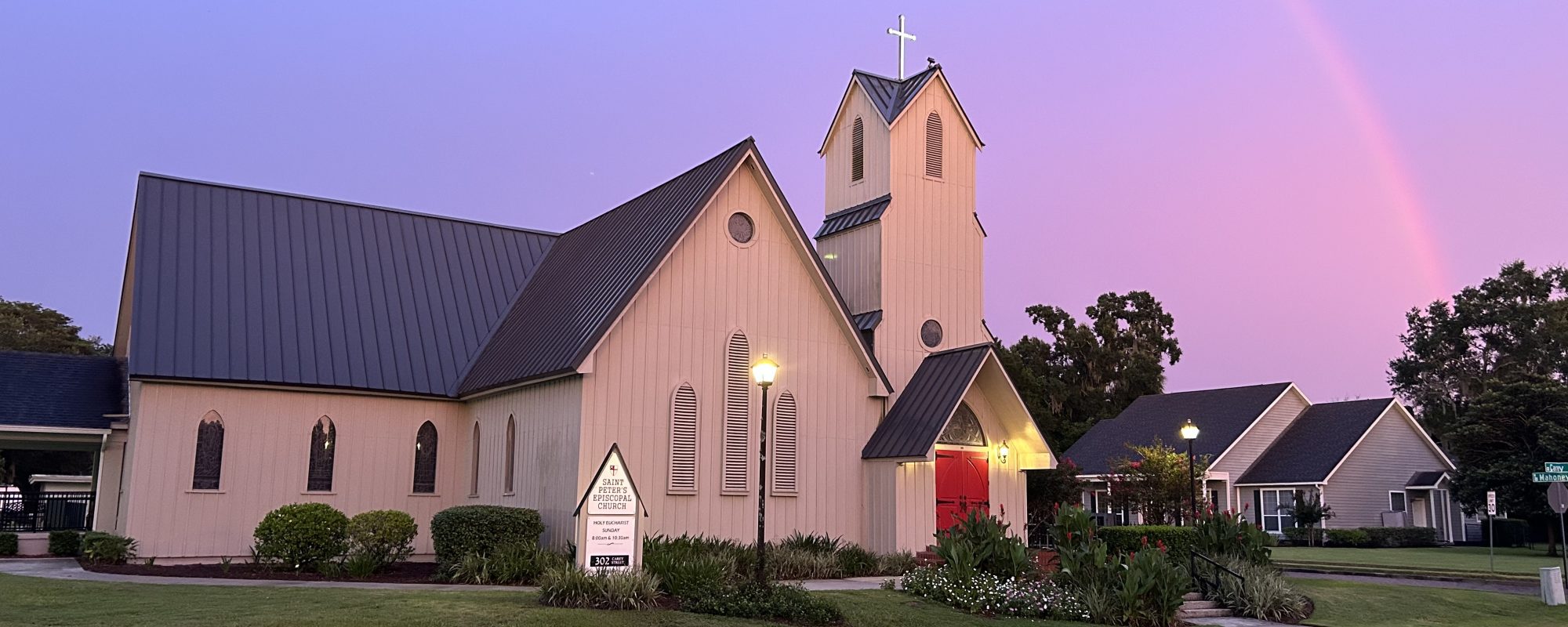
St. Peter’s Episcopal Church
Plant City, FL
The Rev. Derek M Larson, TSSF
Today’s Lectionary Readings:
In the name of God: Father, Son, and Holy Spirit. Amen.
The first 2 or 3 centuries of Christianity was the era of the martyrs. Every one of Jesus’ disciples at some point was arrested, persecuted, beaten, and most to the death. And many of the Christians that followed them found themselves in the same situation. Not in all places and not in all times, but in those early days Christianity—the way of Jesus—was completely countercultural. It was not easy being a Christian in the first two centuries after Jesus.
And it is to that world that the Gospel of Matthew was written, and it was in that context that Jesus speaks in today’s passage.
“Don’t think I’ve come to bring peace to the earth,” Jesus says, “I have not come to bring peace, but a sword.”
At first hearing it sounds completely opposite of what we know about Jesus. The one who says blessed are the peacemakers. The one who says love your enemy. The one who says those who pick up the sword die by the sword.
But here Jesus is not talking about wielding the sword. He’s talking about experiencing the sword. He’s not holding the sword at the hilt, but feeling it’s edge at the neck.
When he says he has not come to bring peace, it’s because peace is not what comes to those who follow in his way of love and justice. Families are separated not because he wants them to be, but because he knows that when people follow him, some of their families will reject them.
The passage we hear today is Jesus warning his disciples what they and their communities will go through if they follow him.
And thus, the passage we hear today is not meant directly for us. Those who live in the 21st century United States, in the land of religious liberty, where Christians, besides occasionally being made fun of, are not persecuted. And yet this is still Scripture. And it is still the story of God and God’s people. And it still has a message for us. The question is, what could this passage possibly say to us in our context?
Many Christians had the same question in the 4th century when the Emperor Constantine replaced the pagan religion of his empire with Christianity. Many Christians watched as the way of Jesus baptized the empire. What for centuries had been the way of love and justice among a small, marginalized and persecuted people that believed in Jesus and his death and resurrection, became the mainstream, everyday kind of religion that was shared among all—the rich and the poor, the powerful and powerless, the soldier and the priest. And for all the wonderful ways that new reality was experienced by Christians, it also completely changed their understanding of the faith.
For the first time, it cost nothing to follow Jesus. For the first time to be a Christian was the background reality of what it meant to belong to the western world and not the defining aspect of a person’s life. Indeed, to not be a Christian would cause persecution by the sword, rejection by your family, and perhaps even execution. And thus the baptism of the empire was also the birth of Christian nominalism—where many were Christians in name but had no depth of personal faith.
And so some people began to ask the same question that we might ask today. What does the Jesus of this gospel passage have to do with us? And they fled into the deserts and the wilderness to find the answer.
They became what we call today the Desert Fathers and Mothers. And there they lived a faith that cost them something. They lived a faith which required something of them. And not just something, but everything. For they knew the way of Jesus is the way of transformation. True Christian faith, changes us.
And so they formed communities in the wilderness where they followed the way of Jesus in a way that would still be counter cultural. In a way that would insist on Jesus’ primary principles of caring for the poor, loving neighbor and enemy, and putting prayer and the worship of God absolutely first. So that every aspect of life would be centered on Christ. They lived the prayer of John the Baptist, “Jesus must become greater, and I must become less.” They carved out a place in the world away from the temptations and demands of mainstream culture so that they might—as Paul writes in our passage from Romans today—die with Jesus so they could also be resurrected with him.
And it is in the inspiration of these Desert Fathers and Mothers that generations of monks and nuns came after them. The early Christians were, what we call, red martyrs, those whose blood was shed to follow Jesus. The Desert Fathers and Mothers were white martyrs, those who gave their lives as living sacrifices.
When Christianity looks the same as the dominant culture, the way of Jesus is deeper. And perhaps our world is not so different than Constantine’s.
What do Jesus’ words about the future hardship of his disciples have to say to us? And what might we learn from the experiment the Desert which asked the same question?
Perhaps this: there are some things more important than comfort. There are some things more pressing than pleasure. And when it would be easy to turn Christianity into a kind of tool for personal comfort and encouragement, perhaps we are being invited to remember that is also has to cost us something. That the way of Jesus is meant to change us. It is meant to transform us. And while yes, we follow a man who proclaims, “Come to me all you who are weary and I will give you rest,” he also says to us, “take up your cross and follow me.”
Yes, he promises us eternal life and resurrection, but he also says to us to come and die with him.
For true freedom, true peace, true comfort, true life comes when we let go of ourselves—our comfort, our pleasure, our desires—and allow the love of God and God’s love to be the center of our lives.
Thanks be to God that letting go does not for us typically mean violence and estrangement from our families. And thanks be to God that not all of us are called into the desert or the monastery (although I hope some of us are). But letting go of ourselves to taking up Christ does mean it will cost us something.
It might mean we have to change our politics. It might mean we have to change to the way we spend our money. It might mean we have to change the way we manage our time and how much of it we give to prayer and to the needs of our neighbors. It might mean offering forgiveness rather than holding a grudge.
The way of Jesus is not always easy. The way of love is not always comfortable. The way of justice is not always what we want to do. To really follow Christ costs us something. But the way of Jesus is worth it. For when we die with Christ we are raised with him. And as Jesus says in our gospel today, when we lose our life for Christ’s sake, we will find it. Amen.
Questions for Reflection
- How is my faith transforming me and what does that cost?
- In what ways is Christ inviting me to go deeper in my faith?
- How might the lives of the Desert Fathers and Mothers inspire everyday Christians today?
 Thoughts on Faith