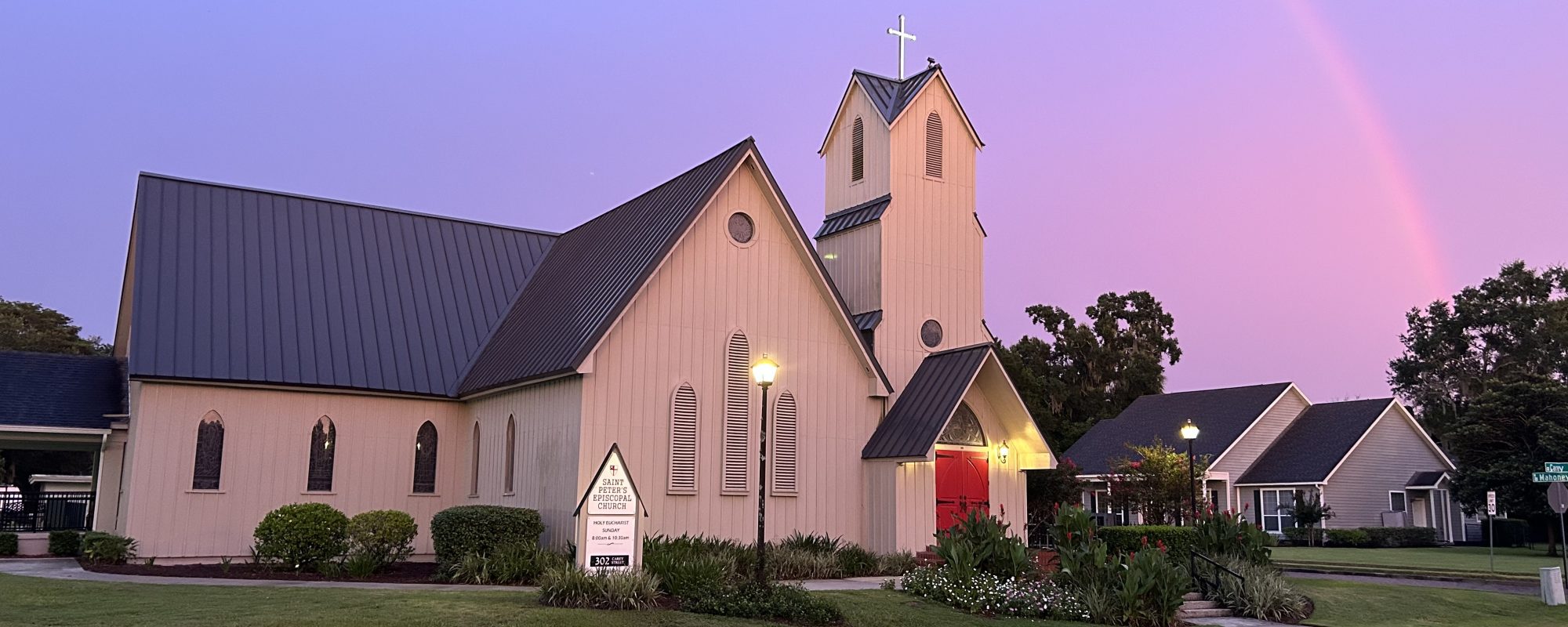
Homily, Penelope’s Prison
The Eleventh Sunday after the Pentecost (Proper 16C), 2025
St. Peter’s Episcopal Church
Plant City, FL
The Rev. Derek M Larson, TSSF
Today’s Lectionary Readings:
Jeremiah 1:4-10
Psalm 71:1-6
Hebrews 12:18-29
Luke 13:10-17
In the name of God: Father, Son, and Holy Spirit. Amen.
There’s a story about a little girl named Penelope, who, when she was five years old, became severely ill with allergies and rashes and hay fever. Her parents didn’t know what was causing it, and so they took her to the doctor where they performed one of those allergy tests to find the exact cause. The one where they prick your back with a series of needles with different toxins on them to see how your body reacts. When she came in with her parents the next day, her back was one giant severe reaction to the toxins. It appeared that Penelope was allergic to everything they had tested her for. You can imagine the worry and fear that brought her parents, and so they went home and installed a special ventilation system and sealed every window and door possible and proceeded to raise Penelope in the safety of their home. It was lonely and sad, but at least she was safe. But at the age of nineteen they discovered that what Penelope was actually allergic to was the aluminum alloy the testing needles were made of, and not everything else. It turns out that Penelope’s fortress of protection had actually been an unnecessary prison. The medicine was actually the disease.
The story comes from the movie, the Brothers’ Bloom, and is inspired by similarly shocking and heartbreaking stories from history, and its theme is one that many of us can relate to. When something that is meant to be for our good becomes instead the source of our suffering. Like when the side effects of our medication become worse than our symptoms. Like when the alcohol we drink to relax becomes the addiction that runs our lives. Like when the diet we adopt for health becomes an obsession that steals our joy. Like when the work that provides for us and gives us meaning in life consumes us until we forget what really matters. Like when the faith that should set us free is turned into judgment and fear.
In todays’ gospel reading, Jesus, while preaching in the synagogue, encounters a woman whose back was bent for 18 years and he heals her. But the leader of the synagogue becomes indignant, frustrated that worship and study had been interrupted by this woman. That Sabbath had been corrupted by the work of healing. This man had dedicated his life to maintaining this holy space as wholly dedicated to God, particularly on the Sabbath—the day in which we let go of all of our earthly anxieties to worship God. But Jesus and this woman had distracted the people from this purpose to focus on her earthly needs. They had shifted the day’s focus from the worship of God to the comfort of men. So his thinking may have been.
And yet the passage tells us that in this moment a woman was set free. And it shows us that a man was still imprisoned. That one left praising God, and one left complaining about people.
In the beginning God created the Sabbath as an instrument of healing. On the seventh day God laid it out as rest for the weary and freedom for the laborers. God offered it as a gift to the world. A tonic—a medicine—a cure—set before humanity if only they take up the prescription. But in today’s gospel we see that the leader of the synagogue’s love for the Sabbath had actually become for him the source of bondage. The gift that was offered by God for the healing of the world had become for him an unhealthy addiction. He had overdosed on the tonic. Misused the prescription. I don’t think he fully realized it, but Sabbath was just a thing he followed to protect his own sense of control and security, like Penelope’s prison, and he had no expectation that it would ever change a thing in his life.
In fact, this man apparently had no expectation that anyone could ever come to worship in pain and leave worship with relief. That one could come to worship stagnant and leave worship transformed. He expected people to leave worship as they came. Sabbath, for him, became a moment to pay homage to the status quo. A time only for giving and not receiving. Sabbath rest and worship was on his lips, but his heart had not felt its true benefits. The medicine became the illness.
Sometimes that can happen in our own worship. Sometimes we allow our worship to become solely a hedge of comfort. We sit in familiar pews, hear familiar hymns, and participate in familiar rituals—not to be healed or challenged, but to protect our sense of security. We resist the sermon that calls us to change, or the prayers that make us confront our own burdens or the bent backs of others.
But within each of us is both a bent over woman and an indignant, controlling man. One feels the weight and pain of this world and longs for transformation. One is afraid of change, and instead clings to the way things are. One enters these doors with the hope that Sabbath will be for her an instrument of true healing. And one prescribes Sabbath as a means to dull the pain and avoid the cure. One prays that in this holy place she will be set free, and one hides in this holy place as a fortress—a prison—of safety and security. Both live within.
I wonder what healing or transformation might need to take place in us today that we would rather not be distracted by. Can you think of something in your life that Christ wants to address but like the leader of the synagogue, you would rather leave for another time and place?
We were never meant to leave this place as we entered it. We were never meant to carry in the weight of our suffering without laying it down. This is a place for transformation. This is a place for healing. And we should never expect to be unchanged here by our encounter with God.
Saint Ignatius called the Eucharist a tonic for the soul, the medicine of immortality. But medicine can be left untaken. And prescriptions can be abused. And so the question becomes what is our intention for being here? For what purpose do we take up this regimen? Has our common worship become a place for our ideals, beliefs, and habits to stay safe from external challenges? Where we can remain more or less comfortable but not fully healed? Or is our common worship a place where we know and expect we’ll be changed?
So what in you needs to be changed?
Penelope’s prison may feel like a safe space, but Christ calls us to take up the medicine God offers—to allow our wounds to be touched, our backs to be straightened, and our hearts to be transformed. God has given us this time and this place for our healing. May we never leave as we have entered. Amen.
Questions for Reflection
- In what areas of my life do I feel imprisoned by my routines or rituals, preventing me from experiencing true healing and transformation?
- How do I respond when challenged to confront my burdens or the burdens of others during worship? Am I open to change, or do I cling to the familiar?
- What fears do I have that might be holding me back from seeking the healing Christ offers in my life?
- Have I allowed my worship practices to become more about maintaining my comfort and security rather than facilitating transformation and growth?
- In what ways might I take a step towards letting go of my past grievances or pains during my time of worship, becoming more receptive to God’s healing presence?
 Thoughts on Faith