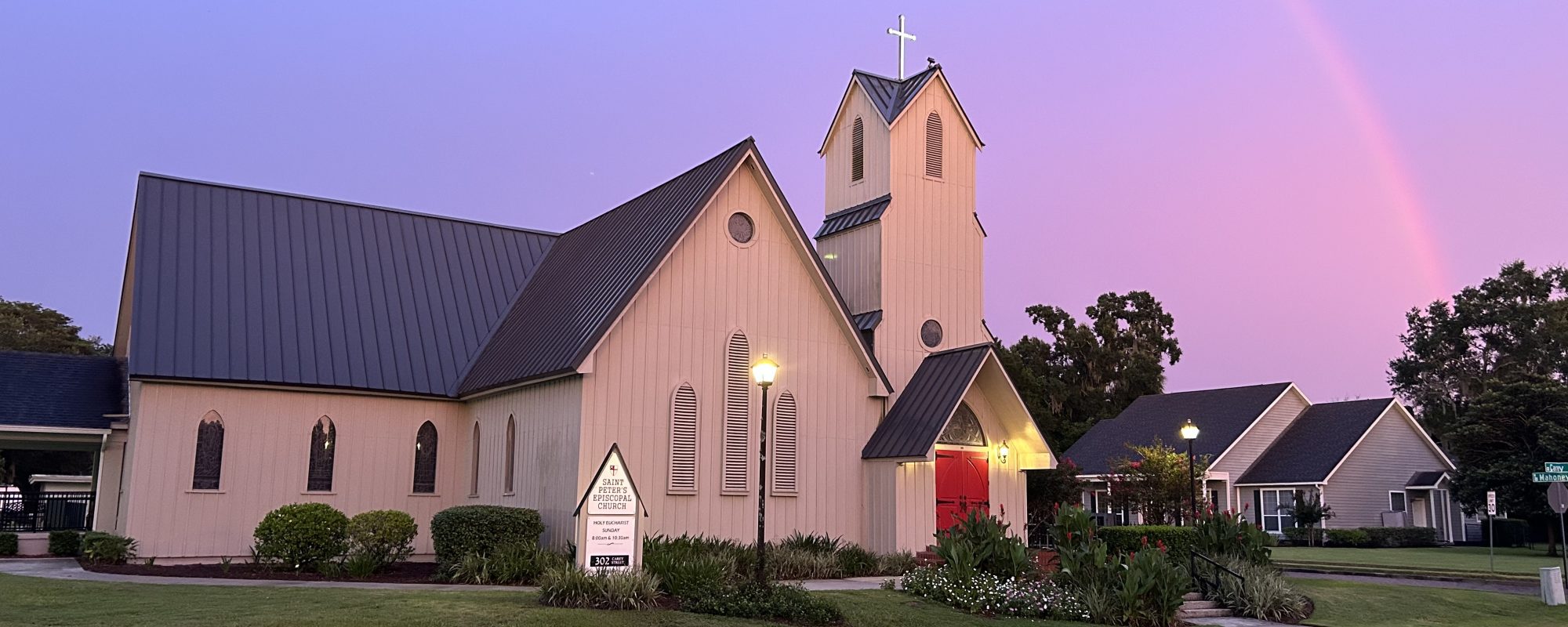
Homily, The Communion of Saints: An Apocalypse
The Feast of All Saints, 2025
St. Peter’s Episcopal Church
Plant City, FL
The Rev. Derek M Larson, TSSF
Today’s Lectionary Readings:
Daniel 7:1-3,15-18
Psalm 149
Ephesians 1:11-23
Luke 6:20-31
In the name of God: Father, Son, and Holy Spirit. Amen.
On the evening of El Día de los Muertos—the evening of the Feast of All Saints—a boy named Miguel sneaks inside the cemetery mausoleum of the famous singer, Ernesto de la Cruz, to borrow his guitar for a music competition. But when he takes the guitar from its stand, suddenly his eyes are awakened to a whole new reality filled with bright colors, and walking skeletons, alebrijes (ormystical creatures), and his own ancestors.

I’m talking about the Disney movie Coco, which we watched at the rectory last night. The movie, inspired by the traditions and cultures of Mexico, goes on to tell a story full of adventure, family secrets, beautiful music, and reconciliation. In the end, Miguel, and the other characters in the film learn the importance of remembering those who go on before us.
The story of Miguel is not unlike the prophet Daniel in our first reading today. Daniel, laying down in bed to close his eyes, suddenly finds his eyes open to mystical creatures—four living beasts rising up from the sea. Our passage skips the majority of the vision so if you want hear the whole story, you’ll have to open your Bibles at home and read it, but at the conclusion of Daniel’s fantastical journey he discovers that while kingdoms come and go, the kingdom of God and God’s holy ones—God’s saints—will live on.
In the Christian tradition we call this genre of story an Apocalypse. In today’s society when we hear the word “Apocalypse” we normally think of the end of the world. But in reality the Greek word apocalypsis literally means revelation, or unveiling. An apocalypse is when eyes are suddenly opened to a bigger reality than what was seen before—not a different reality, but a bigger reality.
The Hebrew and Christian scriptures are full of apocalyptic stories like these with interesting creatures and catastrophic events and fantastical narratives. The Book of Revelation, for example, in the original Greek, is called Apocalypsis—The Apocalypse of John. These stories are not so much about the end of the world but about seeing the world in a new way.
And that’s what St. Paul is getting at in our a reading from Ephesians today. In fact, right there in the middle of the passage St. Paul uses the same Greek word. He writes, “I pray that the God of our Lord Jesus Christ, the Father of glory, may give you a spirit of wisdom and REVELATION (apocalypsis) as you come to know him, so that with the eyes of your heart enlightened, you may know what is the hope to which he has called you.”
St. Paul is calling the Church in Ephesus into an Apocalypse of knowing. Into a new way of seeing. So that our eyes see not only the physical things in front of us, but the mystical things all around us.
And what are those mystical things? What are those things our normal eyes dont’t see? What are the things that feel only real in dreams and fantasy? That amidst the brokenness of this world, God is working for the healing and restoration and reconciliation of all things. That is what most often is beyond our ordinary way of seeing.
According to St. Paul, God has been working since before the foundation of the world to unite all things together in God. To break down borders. To bring an end to all wars. To reconcile family members. To bring us all back into communion with one another. In every moment of every day God is doing that work among us and calling us to do the same if only we have the eyes to see and the ears hear it. If we allow ourselves to experience apocalypse.
When we hear the word apocalypse, we tend to think of the world falling apart. But in truth apocalypse tells us that God is putting the world back together. And so as we look around and see how much of the world is broken, St. Paul prays that the eyes of our hearts will be enlightened to see not only brokenness but to see God working amidst that brokenness to bring restoration. And that with the eyes of our hearts enlightened, we may join God in that work, so that wherever we see brokenness and division, separation and polarization, we might stand not on one side or the other but in the gap bringing hands and hearts together. It doesn’t take enlightened eyes to see the world falling apart; no the apocalypse is seeing the world brought back together.
The apocalypse that St. Paul invites us into, then, is the communion of saints—what he calls a “glorious inheritance.” Those that join God in the work of building restoration and reconciliation. Those who have been shaped by that work. Those who have been shaped not by division, but by communion. A communion so great and so beyond our ordinary way of seeing in this world, that is spans across centuries, and nations, and tribes. A communion so encompassing that it knows no borders—even that great border we call Death.
In Christ, the work of reconciliation is so great that we are in communion even with those who have passed from this life to the next so that if we allow the eyes of our hearts to be enlightened, we’ll see that we are surrounded by a great cloud of witness. We are not alone in this room. Like Miguel in Coco, we are surrounded by the saints—our loved ones, our ancestors, those that have been doing this work for much longer than we have. God’s mission of reconciliation is so great that communion really is the final word.
Today, on the Feast of All Saints, we are being called to more fully participate in this communion of saints. To allow the eyes of our hearts to be enlightened, so that we might step into that great Apocalypse of God supported by the great cloud of witnesses that have passed on this work to us as our inheritance, and join in the work of building communion right here, right now in this world unto the next. We are the communion of saints; we are called to build communion. Amen.
Questions for Reflection
- How does the concept of the communion of saints reshape my understanding of community and connection with those who have passed on before me?
- In what ways can I open my eyes to the mystical aspects of the world around me, recognizing God’s work of healing and reconciliation in the midst of brokenness?
- Reflecting on St. Paul’s message, how can I actively participate in the work of restoration and reconciliation in my own life and community?
- How can I foster a greater sense of unity and communion with others, especially in a world that often feels divided and polarized?
 Thoughts on Faith