Homily, The Man Who Tried to Claim the Sea
The Seventh Sunday after the Epiphany, 2025
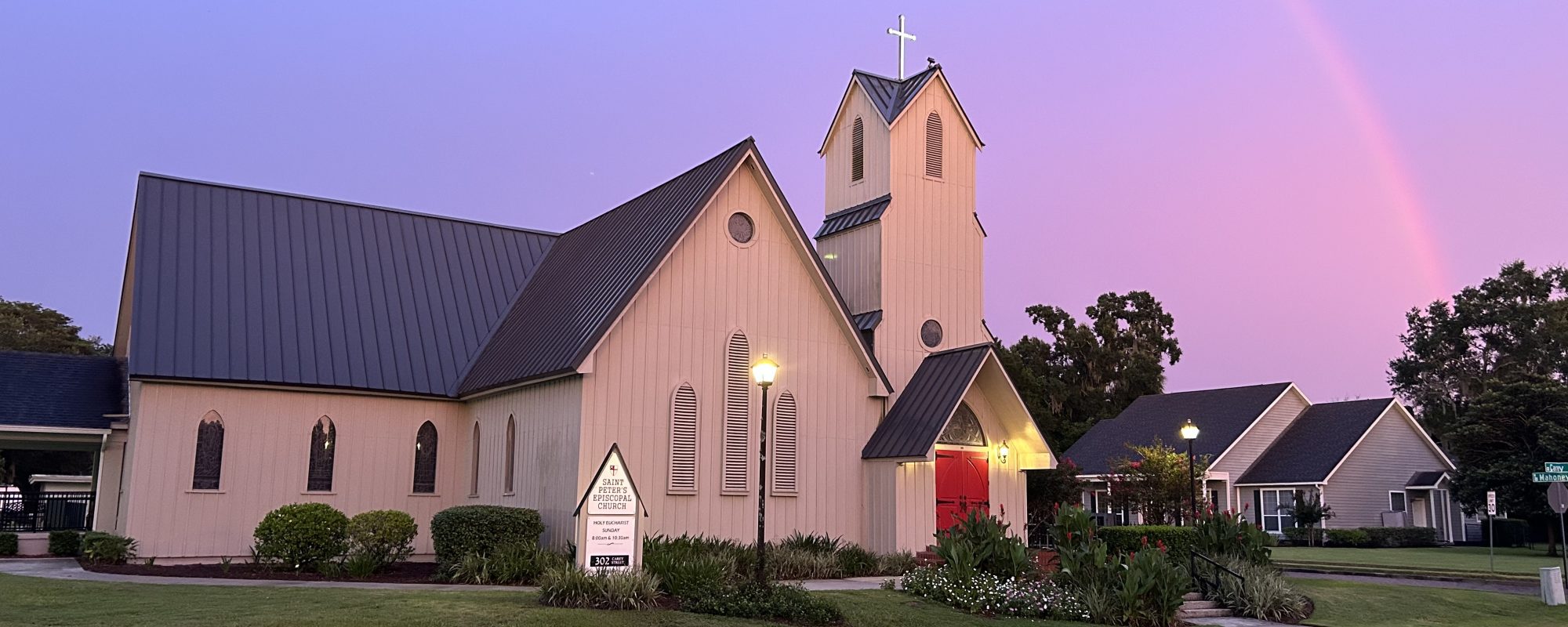
St. Peter’s Episcopal Church
Plant City, FL
The Rev. Derek M Larson, TSSF
Today’s Lectionary Readings:
In the name of God: the Father, the Son, and the Holy Spirit. Amen.
I wonder if you have an enemy. It might be a strong word. If you’re not a soldier or a superhero, we don’t normally use the word “enemy” so much, but I wonder if you have one. Perhaps someone that you dislike, that you hate, someone you know, someone that you don’t know. Perhaps someone that has hurt you, I mean, really hurt you. Perhaps someone that you trusted in the past, but then they abused that trust. Maybe it’s someone you just see on TV, on the news. You see their face, and you hear them talk, and you just clench your fists. I wonder if those folks are our enemies.
Our gospel reading today, Jesus says, “Love your enemy. Do good to those who hate you, bless those who curse you, pray for those who mistreat you.” And I have to say, on one level, that really just sounds like a bad idea. It sounds like a waste of love to offer to someone. Many times, those that we consider to be our enemies are the very ones that we’ve offered love to in the past, and they somehow rejected our love or abused it or misused it. What good does it do to love someone like that? What benefit does it do for them? What benefit does it do for me? It really feels like a waste of love. Not only that, but it feels like a way that I myself can get hurt again.
Let me share a story with you this morning.
The Man Who Tried to Claim the Sea

There was once a man who tried to claim the sea.

“If the sea were mine,” he thought, “I would control the nations of the earth. All ships and boats would come and go only by my word. If the sea were mine.”

“If the sea were mine,” he thought, “I would never go hungry. For all the fish of the deep would belong to me. If the sea were mine.”

“If the sea were mine,” he thought, “when all the people of the earth admire its beauty, they would admire me. I and the sea would be one, at which both they would marvel. If the sea were mine.”

And so the man devised a plan. Brick by brick, stone by stone, he began to build a wall around the sea. After one day of building, he looked on proudly at his work, but with the setting of the sun, the tide washed it away. And so he began again in another place. After one week of building, he looked proudly at his work, but with the coming of summer, a storm quickly washed it away. And so he began again with a thicker wall. After one month of building, he looked on proudly at his work, but soon found that he had run out of brick and stone. And so the wall sat, incomplete, keeping only himself from its water.

“If I cannot claim the sea with a wall,” the man exclaimed, “I shall take it for myself.”

And so he tore down the wall, and bucket by bucket began to take the waters of the sea. Day by day, week by week, bucket by bucket he took its waters. Day by day, week by week, bucket by bucket, the sea remained unchanged, but the man became weary and his body began to ache.

“If I cannot take the sea,” the man exclaimed, “I shall make the sea my home. I will live in it, and it will be mine.” But the man could not swim, and as soon as he threw himself into the sea, he began to drown.

Just at that moment, a fishing boat passed by and the man was saved by its crew, and pulled into the bow. But he shouted at them, spitting and spatting water upon the deck, “What are you doing sailing upon on my sea, catching the fish within the depths of my sea, coming and going across my sea?

But the crew laughed at the foolish man. “Your sea? The sea does not belong to you. You did not create it. You do not control it. You cannot contain it. The sea does not belong to you; you belong to the sea.”
We often think about love as something that belongs to us. Love is that which is within me, and it’s my choice and my prerogative to give it to whom I please and to withhold it from whom I please. We think our love within us is a treasured and limited resource, and if we just give it out willy-nilly to anybody, then we’re going to get hurt by it, and that love is going to lose its value. We often think about love as something that we exchange—you have to be worthy if you’re going to receive my love, and you have to give me something in return.
That’s what we see marriage as, right? It’s the exchanging of vows. Two people make vows for one another: “I’ll love you if you love me.” And we do that in all of our relationships. “I will give you my love, but you have to be deserving of it.”
But what if love was never something that belonged to us? What if love is not that limited resource within us, up to us to choose where to place it? What if love is much, much greater than that?
First John says that God is love. Paul in Acts says, “In God, we live and move and have our being.” What if love is simply the air we breathe, the foundation of our existence that flows all around us, that flows through us? What if love is the presence of God among us, and any love that we share for one another is not love that has come from us, that we are choosing, in our graciousness, to give to one another, but the love that comes from us is actually the love that flows through us? That it is God’s love that is moving through us to the other person that we love.
And in that case, if love is the presence of God flowing through us, flowing around us, sustaining our existence, creating the world that we live in, then when we try to withhold our love, we are just like that foolish man trying to claim the sea, trying to build up walls around love, trying to fill our buckets with love. Love doesn’t work that way.
Love is all around us. It is the presence of God. And whether you like it or not– bring that person to your mind that you thought of at the beginning, someone you know, someone you don’t know, someone on TV, someone you haven’t seen for years. Who is that person?–Whether you like it or not, God loves them. God loves them deeply, just as God loves you deeply. And it may be scary to love that person, but what’s the point in withholding what is already theirs?
God’s love will go where it goes. It is the ocean that we swim in. To hate is to drown. To love is to swim. So when Jesus says to love your enemy, Jesus is inviting you to find yourself in the free flowing love that is the very presence of God, and to allow that love to flow freely, even to your enemies, even to those around you, because it is the love of God that sustains us all.
“To hate is to drown; to love is to swim.”
Will we choose to build up walls around it or contain it, take it with a bucket? Will we choose to claim it for ourselves and drown in it? Or will we simply embrace the love of God as it is here for everyone, it sustains our existence, the very thing in which we live and move and have our being?
So love your enemies. Swim in the grace of God. For love does not belong to you. You belong to love.
Questions for Reflection
- Who comes to mind when I think of the term “enemy,” and how do I currently view my relationship with this person?
- In what ways have I attempted to withhold love from others, believing it to be a limited resource, and how can I open myself to sharing love more freely?
- How does the concept of love as a flowing presence of God change my understanding of my interactions with others, especially those I find challenging?
- What are some practical ways I can actively love those I consider adversaries, following Jesus’ teachings on loving our enemies?
- How can I remind myself daily that I belong to love, and that love is not something I possess but something I can express and share abundantly?
 Thoughts on Faith