Homily, The Pilgrim’s Way
The Second Sunday after Christmas, 2026
St. Peter’s Episcopal Church
Plant City, FL
The Rev. Derek M Larson, TSSF
In the name of God: Father, Son, and Holy Spirit. Amen.
What is the most beautiful place you’ve been to?
Maybe it was on top of a mountain, or at the edge of an ocean, or in a quaint, picturesque village. Can you call it to mind?
When you were there did you think to yourself, “If I only I could stay here.”? “If only I could linger.” “If only I could build a little cabin up here and wake up each morning to a view like this.”
Beauty has a way of doing that to us. It pulls us—invites us—calls us in.
But then for most of us “the real world” sets in. I’m not so sure it is the real world—what can be more real than transcendent beauty? But the practical world at least. “It’s too expensive to live here.” “It would be too far from the rest of my family.” “It’s 2 hours from the nearest grocery store.” “This is not a place I can call home.” And we return to our everyday lives.
In the morning’s Psalm we catch the Psalmist in the midst of that first response to beauty.
“How dear to me is your dwelling, O Lord of hosts! *
My soul has a desire and longing for the courts of the Lord;
my heart and my flesh rejoice in the living God.”
This is a Psalm—a song—not of a tourist, but a pilgrim. In ancient Israel, there were three such pilgrimages that took place every year, in which every able-bodied man was expected to make their way to Jerusalem to make sacrifices and celebrate all that God had done for them. This Psalm was one that pilgrims would sing along the way or upon arrival. It is a song about the beauty of the temple and the presence of God in that sacred place.
But this Psalmist, sings not only of making a pilgrimage, but of making a home in that sacred place. He says, “One day in your courts is better than a thousand in my own room.” She envies the very birds and exclaims, “The sparrow has found her a house and the swallow a nest where she may lay her young; by the side of your altars, O LORD of hosts, my King and my God.” This pilgrim doesn’t want to go home. He wants to linger. She wants to stay. “Happy are they who will dwell in your house! They will always be praising you.”
Which is really what pilgrimage is all about.
In our time and faith, we know less about the practice of pilgrimage. We know about vacations. We know about tourism. But pilgrimage has become a bit more obscure, though it has always been a part of the Christian tradition.
While tourism is about traveling to unfamiliar places to experience and learn about another place or culture, pilgrimage is about traveling to a sacred place to experience and be transformed by the presence of God.
As tourists we travel as visitors, always expecting to return home, maybe with a bit more knowledge or an expanded understanding of the world, but fully expecting to return again to “the real world”.
As pilgrims we leave our home to find “the real world”. We leave behind our day-to-day lives recognizing that there is something more real than the daily grind, and when we return we expect to come home different by the experience. We expect to be transformed by our encounter with the sacred, so that our eyes may see the world anew and our lives be changed.
The ultimate goal of pilgrimage, then, is not a temporary experience, but an eternal one. The Psalmist wants to stay in the courts of the LORD, because this pilgrimage has so shaped them that they want their lives to ever be present to it.
Some pilgrims, then, did stay. I’m thinking of the prophet Anna, for example, who greeted the holy family as Jesus was presented in the temple. The Gospel of Luke says, “She never left the temple but worshiped there with fasting and prayer night and day.” Other pilgrims did go home, but ever carried the experience in their hearts, so that while their bodies may not be physically in the temple, their souls were ever worshiping there. And some went home unchanged, having fulfilled their obligation but without giving themselves fully to the experience. “Happy are the people whose strength is in you, [O God], whose hearts are set on the pilgrim’s way.”
Pilgrimage, then, is both an external and an internal journey, and I encourage you, whenever you have an opportunity to go on a physical pilgrimage. To go to the Holy Land, or to go to Rome, or to go to Canterbury, or to the peaks of the Himalayas, or to the waters of the ocean. Go somewhere not just as a tourist, but as a pilgrim looking for God. Maybe we can organize something together.
But even before and after we go, we can also always be on pilgrimage within our hearts.
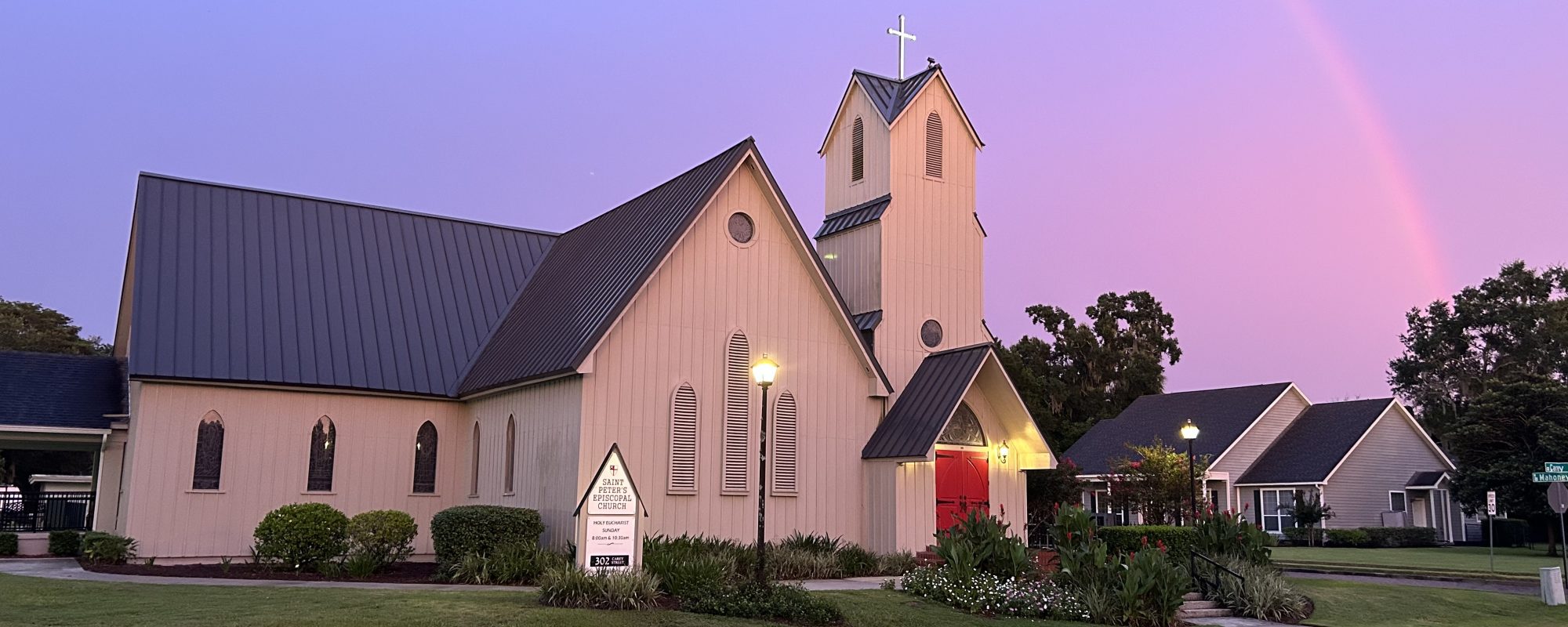
When you come to this place, for example, are you on pilgrimage? Or are you a religious tourist?
When you’re present in this place does your heart sing with the Psalmist, “My heart and flesh rejoice in the living God…Happy are they who dwell in your house?”
It’s okay if the answer is no. Our whole lives are a journey—are a pilgrimage—and we are all in different places in that journey, but the goal is to ever draw more near not just to visiting God, but to dwelling with God in each moment.
I like to think about this in prayer postures. In our tradition there are three primary prayer postures at mass: standing, kneeling, sitting, and all have an important role to play and are appropriate at different places in the liturgy.
The posture of standing, is one of obligation and respect. It is the posture we use when we begin the liturgy, when we sing, and when we hear the words of the gospel. Standing, also, is temporary posture. When we are standing, our feet are filled with potential. We may, at any moment, take a step. Standing in prayer, then, is a posture of visitation. I am here for a moment.
The posture of kneeling, is one of penitence. It is the posture we use in the confession and in certain prayers. It connotes submission and oblation. We give ourselves to God. While more permanent than standing, it is also a temporary posture. Our knees will only cooperate for so long. And we know we are not worthy to stay in the presence of the king forever. Kneeling in prayer, then, is a posture of submission. I am a servant here, for a while, before the king.
The posture of sitting, is one of listening. It is the posture we use as we hear the words of Scripture and the homily. It connotes attention. While standing and kneeling are more temporary, sitting is more permanent. When we sit we say, “I am not going anywhere.” We sit when we are with friends and loved ones. It is a more familiar and intimate posture. We typically don’t sit when we greet strangers or those in authority. Sitting in prayer, then, is a posture of union. The Lord is my beloved, and God is my eternal dwelling.
Standing, then, is the posture of tourism, I am here for a moment. Kneeling is the posture of pilgrimage, I am here to be changed. But sitting is the posture of the home—of dwelling with God. Standing, Kneeling, Sitting: Visitation, Submission, Union.
All three hold potential for an experience with God, but one should always lead to another. The purpose of pilgrimage is to lead us to an eternal dwelling with God.
So where are you in this journey? Are you a visitor in this place? Here to experience God for a moment or for an obligation? Are you a pilgrim in this place? Here to offer yourself fully to God as servant and to be transformed? Are you the beloved in this place? Eternally here to dwell with God? And how is your posture—your pilgrimage—leading you deeper into the life of God?
And here is a closing thought on this 11th day of Christmas: you are the site of God’s pilgrimage. Never forget that God has come down from heaven to dwell with you. As the Psalmist cries out, “How dear to me is your dwelling, O Lord” in Christ, God has also cried out, “How dear to me is your dwelling, O people. My soul has a desire and longing for your heart and home.”
So may the desire of God’s heart find it’s fulfillment in you. May God, for you be a place where you can linger. Where you can stay. Where you can build that little cabin and morning-by-morning bask in God’s beauty. May God be, for you, not only a site to visit, or a place of pilgrimage; but an eternal dwelling place and home. Amen.
Questions for Reflection
- In what moments or places in your life have you felt a deep sense of beauty that made you long to stay or linger?
- Reflect on your current spiritual journey: do you see yourself as a visitor, a pilgrim, or at home in your relationship with God? How does this understanding affect your approach to worship and prayer?
- Consider the different prayer postures mentioned in the homily (standing, kneeling, sitting). Which posture resonates most with you in your current spiritual state, and why?
- How can you intentionally create sacred spaces in your life that allow you to encounter God more deeply and often? What practices can you adopt to foster a sense of pilgrimage in your everyday routine?
- In what ways can you be more mindful of God’s presence in your life and recognize yourself as a dwelling place for God? How can this awareness shape your interactions with others and your community?
 Thoughts on Faith