
Homily, The Treasures of the Church
The Third Sunday after the Epiphany, 2025
St. Peter’s Episcopal Church
Plant City, FL
The Rev. Derek M Larson, TSSF
Today’s Lectionary Readings:
In the name of God: Father, Son, and Holy Spirit. Amen.
“These are the treasures of the Church.”

There is an old story told by St. Ambrose about a deacon named Lawrence. Lawrence was the assistant to the Bishop of Rome in the 3rd century and one of his jobs was to be the administrator and protector of the church’s treasures, it’s gold and riches. In August of the year 258, however, the Emperor Valerian called for all clergy of the church to be killed and for its property to be handed over to the authorities. Lawrence was brought before the Roman prefect and demanded that as keeper of the church’s treasures, he should hand them over. He asked for three days. The church had amassed such a large sum that he needed three days to collect all they had. So for the next three days, Lawrence quickly and carefully distributed all of the church’s money and valuables to the poor. And on the third day he boldly processed to the door of the prefect, who opened it and promptly ordered him to turn over all the church had. But Lawrence looked to the city around him, and pointed to the poor, to the injured, to the suffering and said to the prefect, “These are the treasures of the church, and as you can see, the church is far richer than even your emperor.”
We are in the Season after the Epiphany, the season in which we grow to know Jesus more and more. Every reading of Scripture in our lectionary is carefully selected to reveal something to us about the identity of Jesus. Which is why we pray in our Collect for today, the opening prayer, “that we and the whole world may perceive the glory of Jesus’ marvelous works.”
Our gospel reading, then, is one of those foundational texts to help us understand what Jesus is all about. It is his first sermon in the Gospel of Luke. Jesus stands in the synagogue and is given a scroll. He opens to just the right passage and begins to read, “The Spirit of the Lord is upon me, because he has anointed me to bring good news to the poor, to proclaim release to the captives and recovery of sight to the blind, to let the oppressed go free, and to proclaim the year of the Lord’s favor.”
Now, if you think back to grammar school when you just started to write essays, you’ll remember that you always start writing with a thesis statement. A statement that summarizes what you are going to say in the paragraphs that follow. Well, this is Jesus’ thesis statement. This is the beginning of Jesus’ whole ministry—the sermon he preaches right after being baptized in the Jordan and tempted in the desert. And it is this sermon and this passage of Scripture that summarizes what the ministry and person of Jesus is all about.
And what does it say, “The Spirit has anointed me to preach good news to the poor.” The poor. The center of Jesus’ ministry was his care for the poor. And if we zoom out and look at the story more broadly, particularly in the Gospel of Luke, we will see just how prevalent this central focus was in his ministry. Not only did Jesus speak more about the poor that almost anything in his preaching, and not only did he spend time with the poor and heal their illnesses, he himself lived a life of poverty. As a child he was born to an unhoused family, trying to stay warm in a place meant for animals. As an adult he tells those that would follow him, “Foxes have holes and birds have nests but the Son of Man has nowhere to lay his head.” And on the cross he hung naked without adequate clothing. Jesus, the one we follow and worship, was poor and he came to bring good news to those who were poor.
The gospel, then, at its heart, is good news to the poor. It is other things as well. But at its heart, it is good news to the poor.
Now the thing about the Bible, to paraphrase a movie I grew up watching, is that its like onions. It has layers. And what I mean by that is that sometimes the words of Scripture have multiple meanings that overlay on top of one another.
If we take this passage of Scripture, for example, the first layer, is the most literal. When Jesus says that he brings good news to the poor, what he means is that he is bringing good news to the poor—to people who lack the financial means to make ends meet. To people who struggle to put food on the table and to keep a roof over their heads. To people who don’t know how their medical expenses are going to be paid or how they will get to their next appointment. Jesus came to bring good news to these. To relieve their suffering. To offer them a community that will support them, and care for them, and give them a place of belonging and a way to be freed from the pressures of poverty. And at this layer of Scripture, the meaning for us is that if we are going to truly be people of the gospel—people who follow our Lord and Savior Jesus Christ, a measure of our fruit will be whether or not the poor among us (be it ourselves or those around us) are hearing good news. The late Bishop Desmond Tutu puts it like this, “The church should always be able to get a letter of recommendation from the poor in their community.”
If we keep peeling the onion, however, we realize that when Jesus says he comes to bring good news to the poor, he also means he comes to bring good news to that part within us that is poor. That part within us that is broken. That is suffering. That is barely making ends meet. Jesus came to bring good news—healing—to each one us that carries within us the experience of poverty. And it is each one of us. We all hold within us some form of poverty. And so the measure of our fruit as those who follow Christ is also whether or not those who are broken inside are hearing good news.
These two truths: Good News for those without money and good news for those without hope go hand in hand with one another. If a church is to be faithful to the gospel of Jesus, you can’t have one without the other.
The question this gospel passage brings us to then is this: Who hears good news in our own community? “Today, this Scripture is fulfilled in your hearing,” Jesus said in his own time. Is it fulfilled in our own day?
I think it is. When the unhoused are given the good news of a meal, I think it is. When a person is touched by the phone call of a fellow parishioner, I think it is. When a family has their laundry paid for, I think it is. Jesus is among us and today the Scripture is fulfilled in our hearing.
But the poor are also still among us—there are people sleeping outside in the cold. The broken have not all been healed—there are people that cry themselves to sleep. And so there is still work to be done.
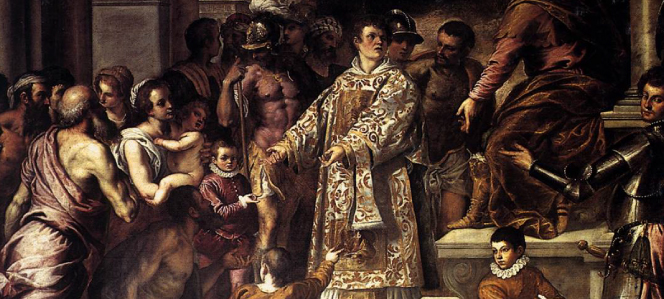
“These are the treasures of the Church,” St. Lawrence said. May we find ourselves, then, rich with good news to share. Amen.
Questions for Reflection
- In what ways can we actively support the poor and marginalized in our community, following the example set by Jesus and St. Lawrence?
- How do we perceive our own personal poverty or brokenness, and in what ways can we seek healing through our faith?
- Reflect on the statement, “The church should always be able to get a letter of recommendation from the poor in their community.” What does this mean for our church’s mission and outreach efforts?
- How does the good news of Jesus resonate with the struggles and challenges faced by individuals in our society today?
- In what specific actions can we fulfill the Scripture that Jesus speaks of, ensuring that good news reaches those who are suffering in our own community?
 Thoughts on Faith