Homily, The Voice of Kindness: What is Your Role?
The Twenty-Third Sunday after the Pentecost, Proper 25B, 2024
St. Peter’s Episcopal Church
Plant City, FL
The Rev. Derek M Larson, TSSF
Today’s Lectionary Readings:
Job 42:1-6, 10-17
Psalm 34:1-8, (19-22)
Hebrews 7:23-28
Mark 10:46-52
In the name of God: Father, Son, and Holy Spirit. Amen.
The sound of chimes gently dancing in the breeze,
or the whispering wind in a tree’s leafy branches,
The sound of a child’s laughter,
or the pages of a book turning.
The sound of a skilled and soulful singer,
or the intake and exhale of a breath.
The sound of thunder in the comfort of blankets,
or the long anticipated knock on a door.
The sound of water in a creek,
or the chirp of birds in the air.
Nothing sounds quite as beautiful as a voice of kindness,
when one feels alone and in need.
But that was not a sound that Bartimaeus often heard. Bartimaeus, whose blindness gave him a sharp ear, could hear everything that happened around him. Daily he heard the sounds of the city while sitting at the gates. The clinking of coins as they dropped in his lap. The conversations that passed, but rarely did he hear the voice of kindness.
And so he was not at all surprised to hear the shushing of the crowd when he spoke up to others; he had heard it before. But he was surprised on this day, the day we hear about in today’s gospel reading, when a voice spoke to him, “Take heart. Get up. He is calling you.”
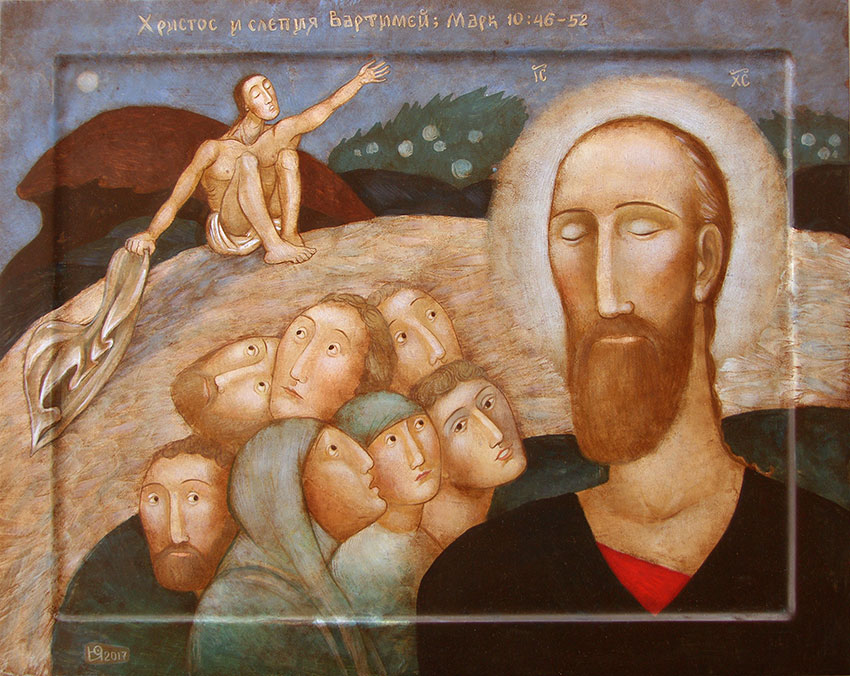
“Take heart.” I’m really fascinated by this phrase. Because there’s not actually a good translation of the word in English. In the Greek, it’s tharseo and here in the NRSV it’s translated as, “take heart”, but in the NASB it’s “take courage”, in the NIV it’s “Cheer up!”, in the KJV it’s “be of good comfort”, in the CEV it’s “Don’t be afraid!”, in the CEB it’s “Be encouraged!”, in the Message, “It’s your lucky day!”. Tharseo—a word that evidently can be translated a thousand different ways, but however we translate it—it is clearly a word of affirmation. A word of hope. A word of encouragement. And thus a beautiful word, especially in the ear of those in fear, pain, or grief. A beautiful word that on this day, unexpectedly fell on the ears of Bartimaeus.
Now normally, it’s Jesus who says this word. It’s the same word he spoke to his disciples as he walked on water towards them in the waves, the same word he used when he spoke to the woman who touched his cloak hoping for healing, the same word he used when he healed the paralyzed man brought to him through a roof, even after his death, resurrection, and ascension, this is the word he spoke in the ears of Paul who had been thrown into prison.
But what’s striking about today’s story, is that this is the only time in Scripture when it is not spoken by Jesus, but by someone else. In this story, it’s not Jesus but those who follow him who get to say it. Jesus does the healing, but his followers get to speak that beautiful word of kindness and hope to Bartimaeus and then usher him into Jesus’ presence. Which is a turn from what they had been doing. At first they had simply ignored Bartimaeus or shushed him. They were concerned only about themselves and preserving their own place in Jesus’ attention. Perhaps they wanted to hear the word for themselves.
But then Jesus commands the crowd to call Bartimaeus to him. And in doing so, Jesus not only heals Bartimaeus, but he shows his followers how to notice and speak the word to someone else, to someone the world has forgotten. Jesus shifts their focus away from being gatekeepers in Christ’s community, to being open doorways. He shares his ministry with them. And allows their words to be an extension of his own to the very one they had previously shushed.
We, too, are being called to share in the ministry of Jesus. To allow our words to become an extension of his. To allow our focus to be shifted away from matters of the inside to those on the outside. To speak a word of hope to someone on the margins.
So here, then, is a question for us as a community at St. Peter’s. Last week we considered our role at St. Peter’s. Are we here to be served or to serve? Are we here as consumers of something St. Peter’s provides for us, or are we here as members of a loving community? This week we ask again about our role at St. Peter’s. Are we here to preserve our own place in Christ’s presence, or are we here to speak hope to those on the outside? Are we here as gatekeepers to this community, or are we here as open doorways, ready to usher those around us into the presence of God?
And how might we know the answer to that question? Very simple. When was the last time you invited someone into this community? Invited someone to St. Peter’s? We as Episcopalians can get uncomfortable with the idea of evangelism. We do not want to be door-to-door Bible salesmen. But I’m not talking about selling Jesus, or converting people. I’m talking about hospitality. The world around us is full of people just like Bartimaeus, folks that long for loving community and a word of hope. And just as Jesus said that day to the crowd, “Call him here,” he says the same to us.
So consider with me your role at St. Peter’s as we prepare for ministry in 2025. How will you speak hope to those outside of our community and welcome them in? Because nothing sounds quite as beautiful as your voice of kindness when one who feels alone and in need. Amen.
Questions for Personal Reflection
- Reflecting on my relationships, who in my life might be feeling isolated or in need of encouragement? How can I reach out to them with a word of kindness?
- How have I experienced or recognized the voice of kindness in my own life? How can I be more intentional about sharing that same kindness with others?
- How can I embrace the idea of hospitality in my life? Who are five people that I can invite into the St. Peter’s community?
 Thoughts on Faith