Homily, The Welcoming Prayer
First Sunday in Lent, 2025
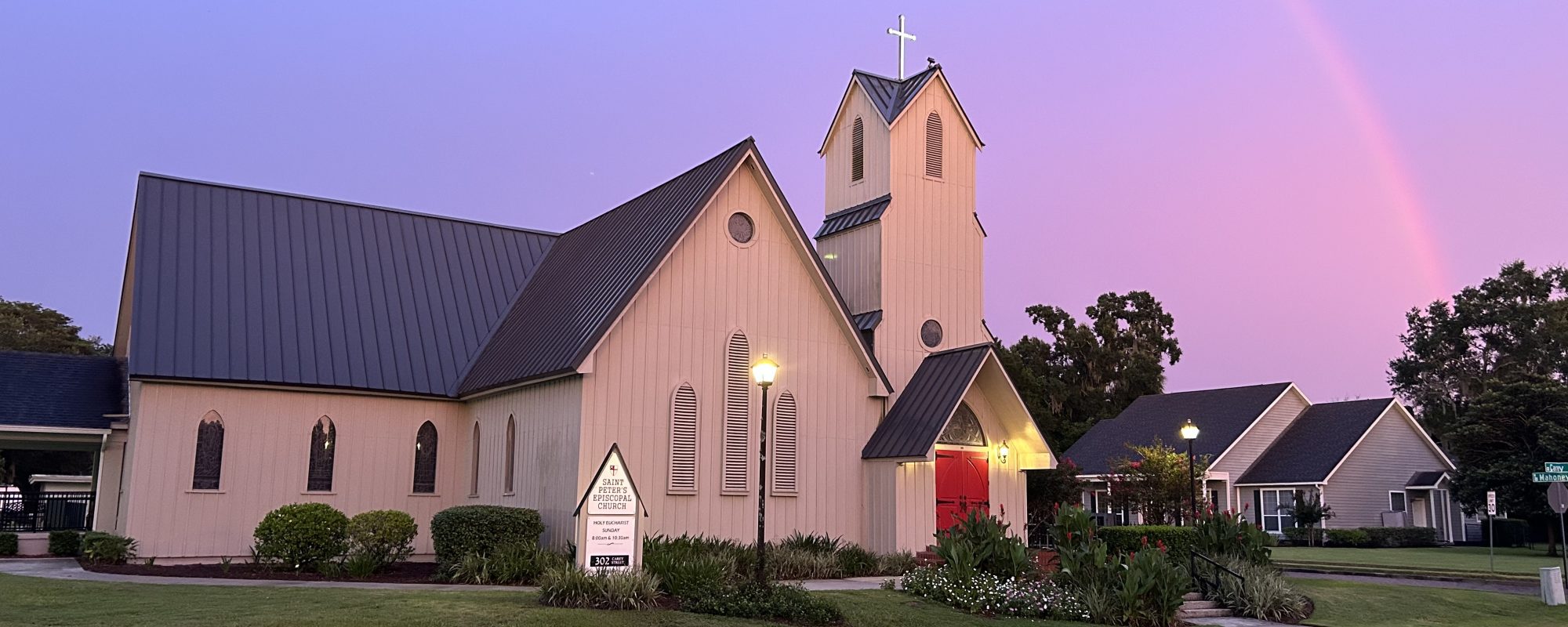
St. Peter’s Episcopal Church
Plant City, FL
The Rev. Derek M Larson, TSSF
Today’s Lectionary Readings:
In the name of God: Father, Son, and Holy Spirit. Amen.
What if the best way to handle temptations is not to fight them but to welcome them? What if the best way to handle fear and anxiety is not to fight them but to welcome them? What if the best way to handle self-condemnation or selfishness is not to fight them but to welcome them?
In our gospel passage today we hear the story of Jesus’ temptation. And one of the most interesting things to me about this passage is that it doesn’t include an epic battle between good and evil! Which is sort of what we might expect in an encounter between the Son of God and a fallen angel, isn’t it? The battle scene between Gandalf and Saruman comes to mind from the Lord of the Rings. Or Luke Skywalker and Darth Vader. Or Harry Potter and Voldemort. But that’s not at all what we find here. Instead, from all appearances the encounter between Jesus and the devil is quite cordial. Yes, there is disagreement, but there are no signs of struggle or aggression.
And yet somehow it works. Jesus neither runs from nor fights temptation, but somehow he avoids its reach. Somehow by simply being present to the devil’s temptations—without putting up a struggle—he is able to respond to them without giving them the power over him they seek.
This notion of welcoming rather than fighting is the core idea of a spiritual practice called the Welcoming Prayer, which I’d like to share with you today.
But first we have to know what we mean by temptations. Typically by temptations we mean the urge to do something bad, or something we know we ought not to do. But the heart of temptation is actually the forgetting or doubting of our own belovedness. In other words, we only do “bad” things when we feel disconnected from the love of God.
We understand this in children, right? Sometimes if a child is acting out at school, it’s because they are going through something at home or elsewhere that makes them question their own self-worth—their own belovedness. And so they take matters into their own hands to carve out for themselves a place in this world.
It’s no different for each one of us. Every act of selfishness, every moment of anxiety, every experience of self-condemnation arises in us when we forget our own belovedness. When we forget our own worth. And we decide to take matters into our own hands to carve out for ourselves places in this world.
That’s what’s at the heart of Jesus’ temptations in today’s gospel passage. Notice the first words, “After his baptism.” This takes place right after his baptism which we can read about in Luke 3. And what happens when Jesus is baptized? When he comes up out of the water he hears a voice saying, “This is my son, whom I love.” And now here, today’s passage, just a few verses later he hears another voicing saying, “If you are the Son of God—If you actually are the Son of God, then you would do this.” In other words, the voice he hears in this moment is making him doubt the voice he heard in the moment of his baptism. And that’s exactly what happens to us. That is what temptation is. It is when we begin to doubt God’s words of love for us, and instead strive to create or protect or own worth.
And here is where the Welcoming Prayer comes in. Often when we experience those feelings which have us doubting our own belovedness, we put up a fight. We work ourselves up and get angry. Or fearful. Sometimes we try to push those feelings away so that we don’t have to deal with them. But in fighting or fleeing those feelings, we end up giving them more power. We end up believing what they say, that we are not important, that we are not valuable, that we are not eternally loved by God.
For example, perhaps we receive some form of criticism from someone in our life—a boss or someone—which may or may not be valid. In receiving that criticism we may find ourselves getting angry, or anxious, or defensive. We may strike back with our own criticism. We may say nothing but harbor ill feelings towards that person. Or we may go away beating ourselves and have a pint of ice cream. Has that ever happened to you?
But when we react in those ways, what we are actually doing is giving power to that criticism over our own self-worth. In hearing the voice criticism, we doubt the voice of God.
But what would happen if we practiced radical welcome in the same moment those reactionary feelings in us began to arise? What would it look like to hear those criticisms and feel those feelings without getting defensive or fighting them? Knowing that whatever someone might say or do, our worth comes not from their words, but from God’s.
That’s how Jesus responds in our passage today. He neither fights nor flees. And he doesn’t give in. Rather than reacting to that which made him doubt through submission or aggression, he responded by being fully present with a gentle but firm resolve. A gentle but firm resolve. That’s the Welcoming Prayer.
It comes to us through the work of Trappist monk, Thomas Keating and his colleague, Mary Mrozowski; inspired by Scripture and centuries of Christian mystics; and has three steps.
Step 1: Notice. Notice when the uncomfortable feelings rise up in you. Notice the temptation. Notice the doubting of your own belovedness. You may need to sit down and take a deep breath to do that, but notice it. But just notice what you are feeling and experiencing.
Step 2: Welcome it. Rather than fighting it or fleeing it, welcome it. Welcoming doesn’t mean giving into it. It doesn’t mean letting it rule over you. It just means being gently present to it. And in welcoming it you take away it’s power over you. You can literally say, “Welcome anxiety.” “Welcome anger.” “Welcome selfishness.” Imagine yourself sitting at the table with it. Not running all over the house, simply sitting at the table.
Step 3: Let go of its power over you. You can say something like, “I see you, I hear you, but I let go of your power over me. I let go of the doubt which makes me question my belovedness. I let go of any desire I have to prove my worth.
And that’s it. Notice. Welcome. Let go. It’s a simple practice. But a challenging and counter intuitive one. If you’d like to try it out or study it more, please reach out and I’ll share with you some resources for learning. But its a powerful practice that helps us remember our belovedness whenever doubts and temptations come our way.
There’s a poem which has been a dear companion of mine for about the last 15 years that really captures the heart of the Welcoming Prayer. I share it with you in closing.
Welcome, Welcome, Welcome.
I welcome everything that comes to me today because I know it’s for my healing.
I welcome all thoughts, feelings, emotions, persons, situations, and conditions.
I let go of my desire for power and control.
I let go of my desire for affection, esteem, approval, and pleasure.
I let go of my desire for survival and security.
I let go of my desire to change any situation, person, condition, or myself.
I open to the love and presence of God and God’s action within. Amen.
Questions for Reflection
- In what areas of my life do I find myself struggling with feelings of self-doubt or unworthiness? How can I recognize these feelings when they arise?
- How do I typically respond to criticism or negative feedback? Can I think of a recent example where I reacted defensively instead of practicing welcome?
- What specific emotions or temptations do I often fight against, and how might welcoming them change my approach to these challenges?
- Can I recall a time when I felt deeply connected to God’s love and belovedness? How can I cultivate that sense of connection more frequently in my daily life?
- How might the practice of the Welcoming Prayer help me to let go of my desires for validation or control in my relationships with others?
 Thoughts on Faith