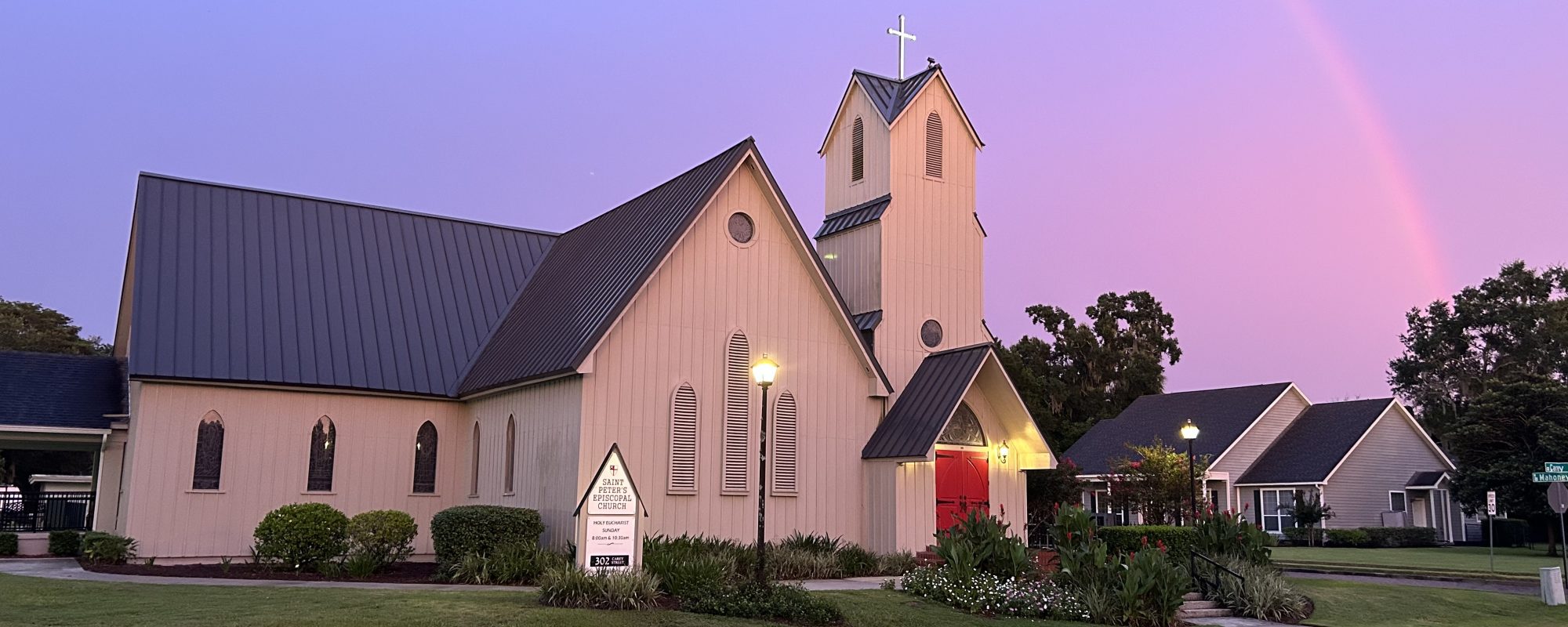
Homily, What is Your Role? Consumer or Community
The Twenty-Second Sunday after the Pentecost, Proper 24B, 2024
St. Peter’s Episcopal Church
Plant City, FL
The Rev. Derek M Larson, TSSF
Today’s Lectionary Readings:
Job 38:1-7, (34-41)
Psalm 104:1-9, 25, 37b
Hebrews 5:1-10
Mark 10:35-45
In the name of God: Father, Son, and Holy Spirit. Amen.
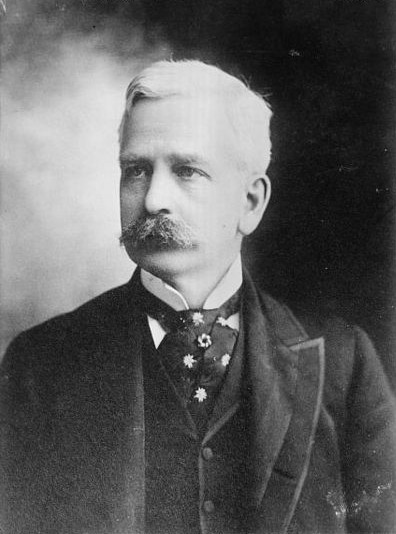
“The customer is always right.” It’s a phrase that revolutionized business. Often attributed to Marshal Field, a successful early 20th century entrepreneur and founder of department stores in Chicago, when it was first coined, it was about turning business into a more relational experience, one where customers were treated with respect and care. Where they were seen not solely as potential dollars but as people. People that would come back and give more business if you simply acknowledge their humanity. But over time, it has morphed into something else. Now, over a hundred years later when that philosophy has permeated our collective consciousness, it seems to have often become a mantra for entitlement, where the consumer expects to get exactly what they want, when they want it, and how they want it with little thought for the person behind the service. And if we, as consumers, don’t get what we want, we expect it to be made right or we’ll take our business elsewhere. If you’ve worked in the hospitality or service industry you know what I’m talking about. We do this all the time. In a way, “the customer is always right” philosophy has almost backfired, so that in always looking to get what we want, we reduce our interactions with others to transactions rather than meaningful connections. It’s hard to be in relationship with someone when your primary role is consumer.
James and John, the disciples of Jesus, lived centuries before Marshal Field and any modern conception of consumer economics, but in our gospel passage today, we see them engaged in the same kind of entitlement that we sometimes fall prey to as consumers. “We want you to do whatever we ask of you,” they say to Jesus. A bold request followed by an even bolder one, “Grant us to sit, one at your right hand and one at your left, in your glory.” It is clear that James and John in this moment, see Jesus not as fully a person, but as a means to get what they want, to have their ambition and desires for power and control satisfied. They like this Jesus product, and they have a sense that they can use it to their own advantage. “We’ll follow you,” they say, “but put us on your left and your right.”
When I read this passage I can almost hear Jesus chuckle, “You have no idea what you’re asking for. You don’t even know what you’re talking about. This path is not about getting what you want, it’s about giving what others need. The Son of Man came not to be served, but to serve.”
You know sometimes, I think that our mindset is a lot closer to that of James and John than we think. For example, in a world where one of our primary identities is consumer, sometimes we come to church and still playing the part of consumers. We shop around for the church that gives to us just what we’re looking for, and we sit in its pews ready to be served. Ready to be comforted. Ready to be encouraged. And then, having more or less satisfied our needs, we gratefully say goodbye until next time. Church becomes something meant to meet our own spiritual wants and needs.

In our gospel reading today, Jesus, then, offers an alternative vision. The community of faith is not primarily a place to be served, but to serve. If our proximity to Jesus in this place is primarily about meeting our own needs, than we are missing out on Jesus’ greater purpose of meeting the needs of others.
Now don’t get me wrong. I hope that you do come to St. Peter’s with your needs. I hope you come to this place with all your doubts and fears and pains and concerns knowing that in this place you will find solace. You will find comfort. You will find encouragement and affirmation that you are beloved. But the solace you will find in this place is not the kind you can purchase with your presence or with what you place in the offering plate. We are not consumers here, but members of a community. Brothers, sisters, siblings that love and care for one another, and serve each other and the world around us.
That’s what James and John were missing. Notice that in the same moment they come to Jesus to have their request satisfied, they step away from the community of faith that surrounded them. And when they return, the other disciples are hurt and upset by the way they have prioritized themselves over one another. James and John are acting as consumers of Jesus rather than members of the community of Jesus. And it can be so easy for us to fall into the same mindset. Jesus’ vision is not one in which we are consumers, (and neither is it one in which we are indentured servants ever waiting on entitled guests). Jesus’ vision is one of loving mutuality, in which all people are seen as people, caring for and serving one another and the world around them. Consumerism tells us that satisfaction comes from getting what we want. But in Jesus’ way, we discover a deeper fulfillment—not by being served, but by serving others, and by doing so, we become a community where love is given and received freely.

This week we begin our 2025 stewardship campaign: St. Peter’s Day-by-Day. The idea is that the ministry of St. Peter’s is something that happens in our daily lives together, and so as we plan for what ministry will look like for St. Peter’s in 2025, we invite you to consider your role in that ministry. How will you take part in this community? How will you live into Jesus’ call here at St. Peter’s? What is your role? St. Peter’s is a Christian community, as we say in our mission statement, not a product. We are here not primarily to be served but to love and serve one another and the world around us in community. And if we, like James and John, come to this place not primarily as members of loving and serving community, but as consumers, we’re missing out on all that Jesus has for us.
The Son of Man came into the world, not to be served, but to serve, and to give his life as ransom for many; let us too come into this place not to be served but to serve, knowing that in doing so, we’ll find ourselves loved and cared for in ways far richer than consumerism could ever offer. Amen.
Questions for Deeper Reflection
- In what ways have I approached my faith community as a consumer rather than as a member of the community? How might I shift this perspective?
- How do I typically respond when my needs are not met within my church or faith community? What does this reveal about my mindset?
- What specific roles or actions can I take to contribute to the loving, serving community that St. Peter’s calls us to embody?
 Thoughts on Faith