Why Vegetarian?

LauraAnn and I have been vegetarians now for more than 12 years, and our boys have grown up with only a vegetarian diet. Sometimes we get questions about what that means and why we choose a vegetarian diet, so I thought I’d write a short blog post about.

I want to be upfront that our choice of a vegetarian diet is completely personal. We do not believe that everyone should be a vegetarian, and we do not cast judgment on those who eat meat. We don’t at all mind people eating meat around us, and we don’t even mind meat being in our house. We just don’t eat it personally, that’s all. Here’s what that means for us.

What is a Vegetarian Diet?

To be vegetarian family simply means that we don’t eat meat. Or to be more direct, we don’t eat animals. There are similar diets that we have tried in the past (such as vegan or pescatarian), but they are different. A vegan diet means that you don’t eat animals or anything that comes from them (including dairy, eggs, and sometimes honey). A pescatarian diet means that you eat seafood but no other meat. As vegetarians, we do eat dairy and eggs (though we try to be more conscious of where they come from), but we do not eat fish or any other animals. 

Why a vegetarian diet?

For me, there are four reasons. 

1. Compassion for animals.

    The vast majority of meat produced in the United States and other places comes from abused animals. I mean this in quite a literal way. What you’d go to jail for doing to a dog, is the normal treatment of cows, pigs, and chickens in factory farming. Most of us simply would rather not know “how the sausage is made.” When LauraAnn and I learned a bit about the meat industry, meat lost its appeal. 

    That said, there are non-abusive ways of getting meat. Hunting or buying from your local farm is a great alternative. We just decided to keep it simple and not eat meat at all. 

    2. Compassion for our bodies.

      From our research, a plant-based diet that reduces the consumption of meat (especially red meat), is significantly better for the body. And taking care of our bodies is important.

      3. Compassion for the environment.

        Surprisingly, the meat industry is one of the biggest contributors of carbon emissions and thus climate change. My understanding is that eating a vegetarian diet has a greater positive impact on the environment than even switching to an electric vehicle.

        4. Compassion for the poor. 

          It takes a lot of food and land to produce livestock, and we’d have more food to feed the global hungry if those resources were redirected directly to people rather than the animals we raise to eat. We decrease the amount of food available to the human population when we eat meat.

          These four reasons have guided us to our family’s decision to eat a vegetarian diet. I don’t write as an expert on these issues, just as someone doing the best I can to cultivate compassion in the world and in our family life. Lots of others come to other decisions, and that’s perfectly okay! No judgement here. I encourage us all to prayerfully do the best we can with the information that is given to us.

          Vegetarianism and Faith

          You’ll notice that in my reasons I haven’t explicitly cited Scripture or my faith. Faith is certainly a huge influence in my intention for being a vegetarian, but it is not a Scriptural or doctrinal mandate. There is nowhere in Scripture that says you should reduce your meat consumption and there is no Christian doctrine that says you should be a vegetarian. That said, there are many Christians throughout the centuries that have become vegetarians or have had plant-based leaning diets. I think that’s because when we cultivate compassion in our lives and seek to find God’s presence in everything around us, it inevitably effects the way we see animals and the way we eat as well. Does my faith have something to say about the way I eat? I say, yes. Some of the Christians and religious leaders that influenced me the most in my vegetarian diet may surprise you: early Christian monks and nuns, Francis of Assisi, John Wesley, Leo Tolstoy, Mahatma Gandhi, and… Mr. Rogers!

          What do the larsons eat?

          We eat a lot! And especially fruits and vegetables, of course! These days though there is a vegetarian substitute for almost everything, even hot dogs. So our diet doesn’t actually look that different from a lot of others. We just substitute the meat for something else. Impossible Burgers and Beyond Burgers are delicious! Generally though, we eat lots of Italian and Mexican foods, which are easy to make vegetarian. We’re always up for trying a new vegetarian dish.

          Honestly, after 12 years of not eating meat, we hardly even think about our diet anymore. It’s not something hard to do, though at first there might be a learning curve. People tell me all the time that “they could never be a vegetarian,” and maybe that’s true, but when I became a vegetarian I didn’t even like vegetables. I started small. I reduced red-meat consumption. I ate vegetarian for Lent. I tried new things. It was something I learned and came to love. Maybe you would like it to!
          Final Homily at Good Shepherd

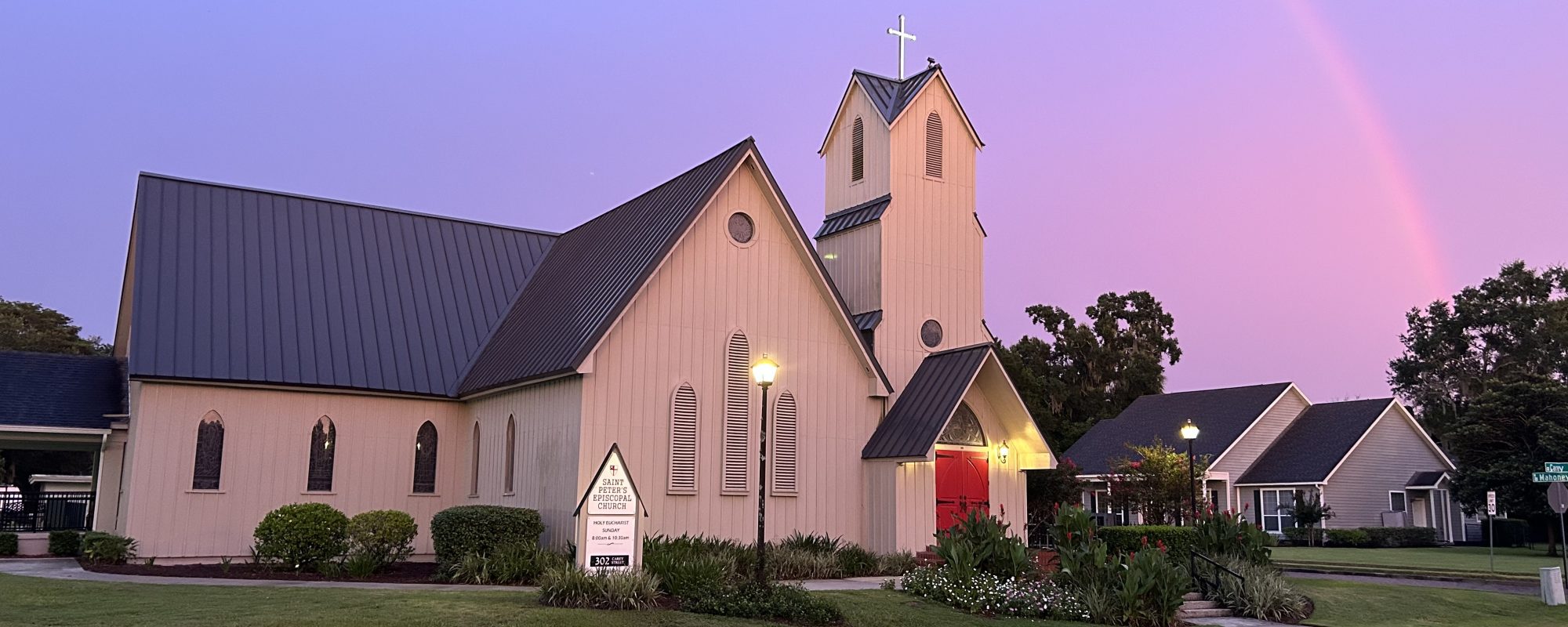
          Yesterday my family said goodbye to Good Shepherd after being with them for three years and 6 days. It was an amazing three years and six days, and we are incredibly grateful to have been part of such a wonderful community. We will miss them dearly, even while being excited to join our new parish family, St. Peter’s Episcopal Church in Plant City, FL.

          Here is my last homily at Good Shepherd. You can find the full text of the homily here.

          New Homily and More: Casting Out, Welcoming In

          Find the full text of the homily here.

          RESOURCES FOR FURTHER REFLECTION

          Prayer Practice: The Welcoming Prayer

          The prayer of welcoming grace into things unwanted or uncomfortable resonates with the Welcoming Prayer, developed by Mary Mrozowski, a lay contemplative, and Thomas Keating, a Trappist Monk. This has been one my core prayer practices. Click the above link to learn more about the practice.

          Homily: The Welcoming Prayer

          I also preached a sermon on the Welcoming Prayer a couple years ago. Find it at the link above.

          Teaching from the Book of Occasional Services on Exorcisms

          There is a very brief explanation of exorcisms in the Episcopal Church’s Book of Occasional Services. If you are interested in learning more, click the above link and scroll down to page 233. While you are there, look at some of the beautiful occasional services included in the book.

          Poem: Roommates

          I thought when peace moved in
          she’d send anxiety a notice of eviction.
          Instead she became his roommate.
          And at night when he paces the living room,
          she makes him a cup of tea.
          And in the morning when he snoozes the alarm clock,
          she lets in the sunlight.
          I thought when peace moved in
          anxiety would move out.
          But anxiety didn’t go anywhere.

          He’s still there.
          He’s just no longer alone.

          Big News!

          After three incredible years serving as the Associate Rector at Good Shepherd Episcopal Church, I have now been called to serve as Rector at St Peter’s Episcopal Church Plant City, Florida!

          Good Shepherd has been such a wonderful home for us and we are so grateful to our friends and parish family here. It will not be easy to leave. I have loved working with Sanford Groff and all of our staff and volunteers, and they will continue to do great things with Good Shepherd.

          And yet the Holy Spirit is moving in some exciting ways and leading us to a really wonderful parish in St. Peter’s, a community with which we already share so much in common.

          St. Peter’s is also just down the road from where I grew up. And now our boys will get to grow up near their grandparents, aunts, uncles, and cousins!

          Please pray for us as we make this transition! My last Sunday at Good Shepherd will be July 21st and my first Sunday at St. Peter’s will be August 18th.

          New Homily and More: The Face of Jesus

          Find the full text of the homily here.

          Resources for Further Reflection

          Song: Turn Your Eyes Upon Jesus

          If I were a baptist or pentecostal preacher, this is the song I’d ask the band to play at the altar call after the homily (and Shane and Shane do it so well!). It preaches the message much better than I have. I like to listen to this song while praying with an icon of Jesus, and looking upon his face. Perhaps it will help calm your fears as it has mine.

          Book: Moments with Jesus: Encounter Bible by Bill Johnson, Eugene Luning and Illustrated by Kristen & Kevin Howdeshell

          Alongside of the text of this homily, I’ve posted pictures from one of my favorite children’s Bibles, Moments with Jesus. What is unique about this Bible (and it is NOT just for children) is that it tells the story in the second person as an imagined, meditative experience and includes reflection questions. Plus the illustrations are beautifully fantastic! In the book’s telling of Jesus calming the storm, it invites the reader to imagine what it would have been like to be on the boat. It also asks these two sets of questions: (1) Have you ever felt as scared as the disciples in the storm? What made you afraid? and (2) Picture that scary moment in your imagination, but this time picture Jesus there with you. Is He scared? What is He doing? What is He saying? How do you feel about that

          New Homily and More: The Speed of Poetry, The Speed of God

          Find the full text of the homily here.

          RESOURCES FOR FURTHER REFLECTION

          Livestream: The Poetry Broadcast by Billy Collins
          Billy Collins continues to read poetry for the world on his Facebook page every Tuesday and Thursday at 5:30pm. Join him at the link above.

          Poem: “Introduction to Poetry” by Billy Collins
          This classic poem of Collins draws a distinction between approaching a poem as something to be solved or unlocked rather than poetry as something to be playfully and creatively experienced. I think we are often tempted to read parables the same way. Rather than playfully turning our attention to them, we become too academically rigid in our approach, expecting there to be some single correct answer or solution to the parable.

          Book: Practicing the Presence of God by Brother Lawrence
          This book was written in the 16th century by a Carmelite Friar and is a classic. The book speaks about cultivating an awareness of God’s presence in every moment, even in (and especially in) the mundane.

          Book: Wherever You Go, There You AreMindfulness Meditation in Everyday Life by Jon Kabat-Zin
          This book, from outside the Christian tradition, teaches some of the basic concepts of mindfulness meditation and the art of paying attention. First published in 1994, it has become a consistent best-seller in the area of spiritual practice and living well.

          New Homily and More: Hallowed Rest

          Find the full text of the homily here.

          Resources for Further Reflection

          For more reflection on Sabbath rest and a deeper engagement with this passage, check out the following resources that inform my thinking on the topic. 

          Book: The Sabbath by Abraham Joshua Heschel

          Rabbi Heschel is one of the most influential theologians and teachers of Judaism in the 21st century. Dr. Martin Luther King, Jr. called Rabbi Heschel “his Rabbi” and “a truly great prophet”. Heschel’s book on the Sabbath is a short but incredible read that I highly recommend. It completely changed my perspective and I continue to reflect on its words.

          Podcast: “Sabbath and the Art of Rest” from the Ezra Klein Show

          In this episode, Ezra Klein interviews Judith Shulevitz about her book, The Sabbath World: Glimpses of a Different Order of Time. They speak not only about the observance of the Sabbath itself, but how the conception of time, morality, and community are shaped by its observance. 

          TV Episode: “Relax” from the show, Bluey

          This is the episode I reference in my homily from the award winning, relatable, and moving Australian children’s show, Bluey. I highly recommend not only this episode, but the others as well! Its on the Larsonage TV screen regularly.

          Study Guide: “Sabbath Practices” from The Thoughtful Christian by Dorothy C. Bass and Carol A. Wehrheim

          This little study guide (meant for groups, but can be used by individuals) was shared with me by our office coordinator, Mary Lou, and I found it really helpful and enlightening. If you would like to spend some time learning more about the tradition of keeping Sabbath and reflecting on how rest shows up in your life, I recommend it. 

          Song: “Slow Me Down” by the Porter’s Gate

          While not about the Sabbath specifically, this song by one of my favorite artists captures the call of the homily to slow down and rest in the deepness of God’s peace. The refrain’s use of “Good Shepherd” is an added bonus. 

          Song: “Slow Me Down” by Robby Seay Band

          Another song by another band, but with the same name, this song also captures the call to slow down in the presence of God. 

          New Homily (and More): With Sighs Too Deep for Words

          Find the full text here.

          Also, I’m trying out something new on the website. With each homily I’m going to start posting some resources connected to the Scripture passage and message I spoke on for deeper reflection. Below are the resources for this week. You can also find them on the homilies page. Let me know if you find it helpful or if you have suggestions!

          Resources

          For more reflection on this passage from Romans and the practice of wordless prayer see some of the following, and never hesitate to reach out for a conversation!

          Song: Spirit Move! (Keep on Moving) by the Porter’s Gate
          This song based on Romans 8:22-27 is from a new album by one of my favorite music artists, The Porter’s Gate. It was the soundtrack for the writing of this sermon.

          Web Article: Learning to Pray from the Spirit and the Heart by Fr. Jack N. Sparks
          This web posting is an adaptation of an old teaching on prayer from the 16th century by priest, Lorenzo Scupoli. I found it really helpful in framing the different types of prayer and praying from the Spirit/heart.

          Organization: Contemplative Outreach
          https://www.contemplativeoutreach.org/
          One of the methods of wordless prayer that has been part of my practice is called Centering Prayer, inspired by the ancient monastic tradition and contemporarily developed by Fr. Thomas Keating, a Trappist Monk. Contemplative Outreach is the primary organization that teaches about centering prayer and organizes groups around the country. Below are a few more resources on Centering Prayer.

          Group: Centering Prayer Group at Jupiter FIRST Church
          Meets on the fourth Monday of each month
          https://www.jupiterfirst.org/spiritualformation/

          Book: Open Mind, Open Heart by Thomas Keating

          Book: Centering Prayer and Inner Awakening by Cynthia Bourgeault